

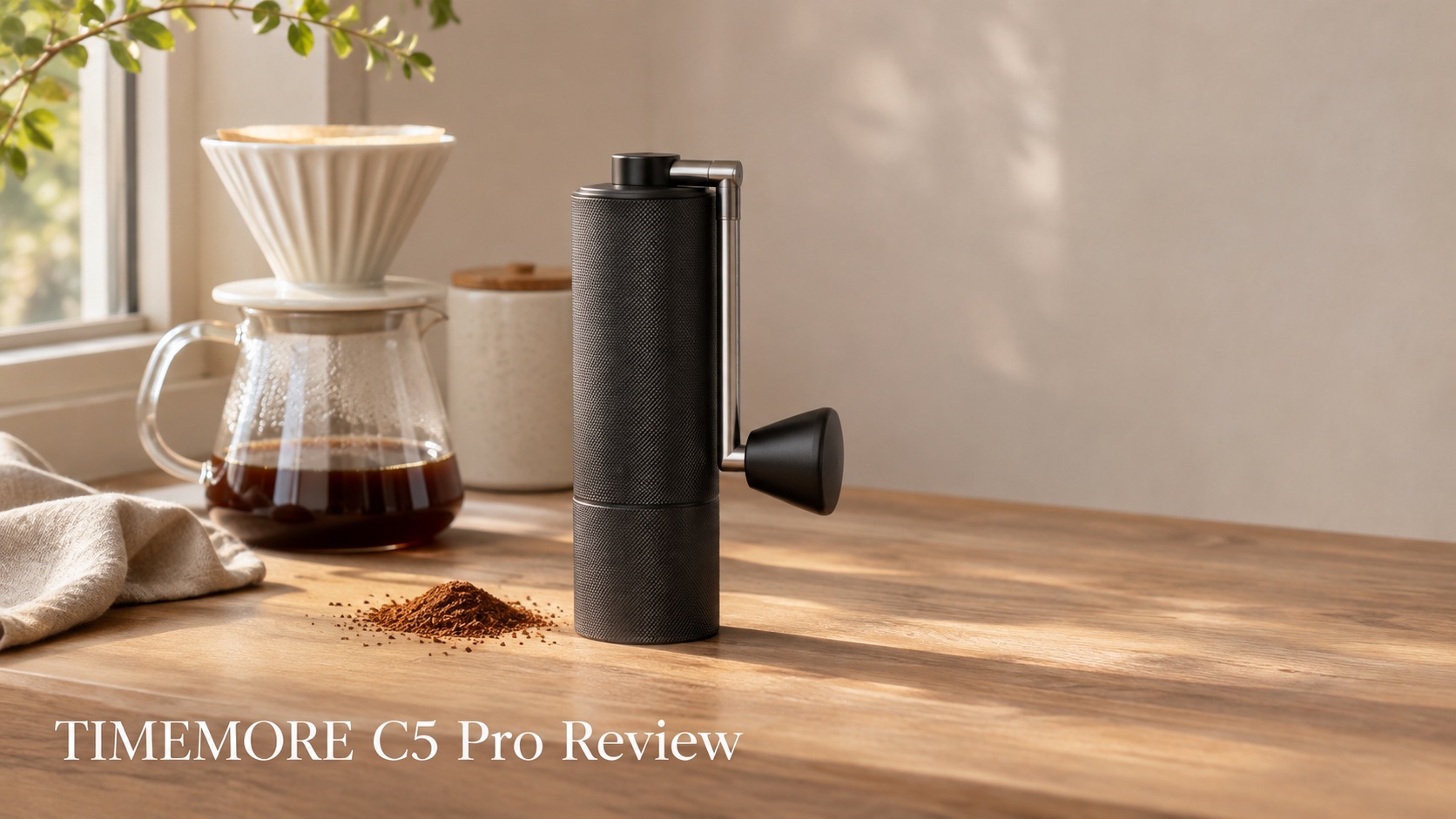
TIMEMORE C5 Pro Review: Buy It for Filter, Not for Espresso
TIMEMORE C5 Pro Review: Buy It for Filter, Not for Espresso
1. The TIMEMORE C5 Pro Verdict, in Two Sentences
The TIMEMORE Chestnut C5 Pro is the C3 done properly: a bigger 42 mm burr, a metal body and a folding handle for US$110, and it makes sense for a pour-over brewer buying a first serious hand grinder. It is not an espresso grinder in any practical sense, and if you can stretch to US$159, the Chestnut S3 is the better long-term buy.
2. TIMEMORE C5 Pro Specifications at a Glance
Specs and prices checked 20 November 2026 on TIMEMORE’s official C5 series page, with independent reviews from The Coffee Chronicler and Pull & Pour. Models and pricing change without notice.
| Specification | TIMEMORE Chestnut C5 Pro |
|---|---|
| Model class | Manual conical burr grinder, entry Chestnut C series |
| Burr | S2C-042-III, 42 mm, stainless steel, seven-sided conical |
| Adjustment | Internal stepped dial, 48 clicks per rotation |
| Step size | 0.031 mm per click (manufacturer figure) |
| Range | One full rotation covers every setting |
| Capacity | 30 g grind chamber, 25 g catch cup |
| Size | 53 mm diameter, 172 mm tall |
| Weight | About 640 g |
| Materials | Aluminium alloy body, stainless steel burr and shaft |
| Handle | Folding |
| US price | US$110 on timemore.com (Black or White) |
Two numbers in that table need context. TIMEMORE states the 0.031 mm step as how far the burrs move per click, which is not the same as how much the grind size changes. And the 25 g catch cup is the real limit on a single dose, not the 30 g chamber.
There is no Singapore list price we could verify on 20 November 2026. If you buy locally, check a specialty stockist and expect GST and shipping to move the number.
3. TIMEMORE C5 vs C5 Pro, and the Rest of the Family
The C5 series launched in 2025 as the successor to the C3 at the affordable end of TIMEMORE’s Chestnut range. It comes in three versions, and the naming is less helpful than it looks.
- C5: the base model, fixed handle
- C5 Pro: the same burr, the same dial, the same 31 micron step. The only difference, according to both The Coffee Chronicler and the retailer Slow Pour Supply, is the folding handle
- C5 ESP Pro: the folding handle plus a finer dial, 0.015 mm per click and 50 clicks per rotation, with three full rotations of range. US$115 on timemore.com
So “Pro” here does not mean a better burr or a better grind. It means a handle that folds against the body, which matters if the grinder lives in a drawer or a bag. On 20 November 2026, TIMEMORE’s own US store listed only the Pro and ESP Pro versions, with the series “from US$110”. The plain C5 is sold through regional retailers at prices that vary too much to quote as one figure.
4. Who the C5 Pro Is For, and Who It Is Not
✅ Buy it if
- You brew pour-over, AeroPress or French press and want your first proper burr grinder
- You make one or two cups at a time. A 25 g catch cup is plenty for that
- Your budget tops out around US$110 and you want metal, not plastic, in the body
- You want something that packs flat. The folding handle is the point of the Pro
⛔ Skip it if
- Espresso is your main drink. The dial is too coarse, and grinding is slow (see section 6). Look at the C5 ESP Pro at minimum, or the S3
- You already own a working C3. The burr is better, but not by enough to justify replacing a grinder that works
- You change grind size several times a day. The dial is inside the body, under the burrs. The S3’s external ring is far easier
- You brew for four people. 25 g at a time means grinding twice
5. Build and Design
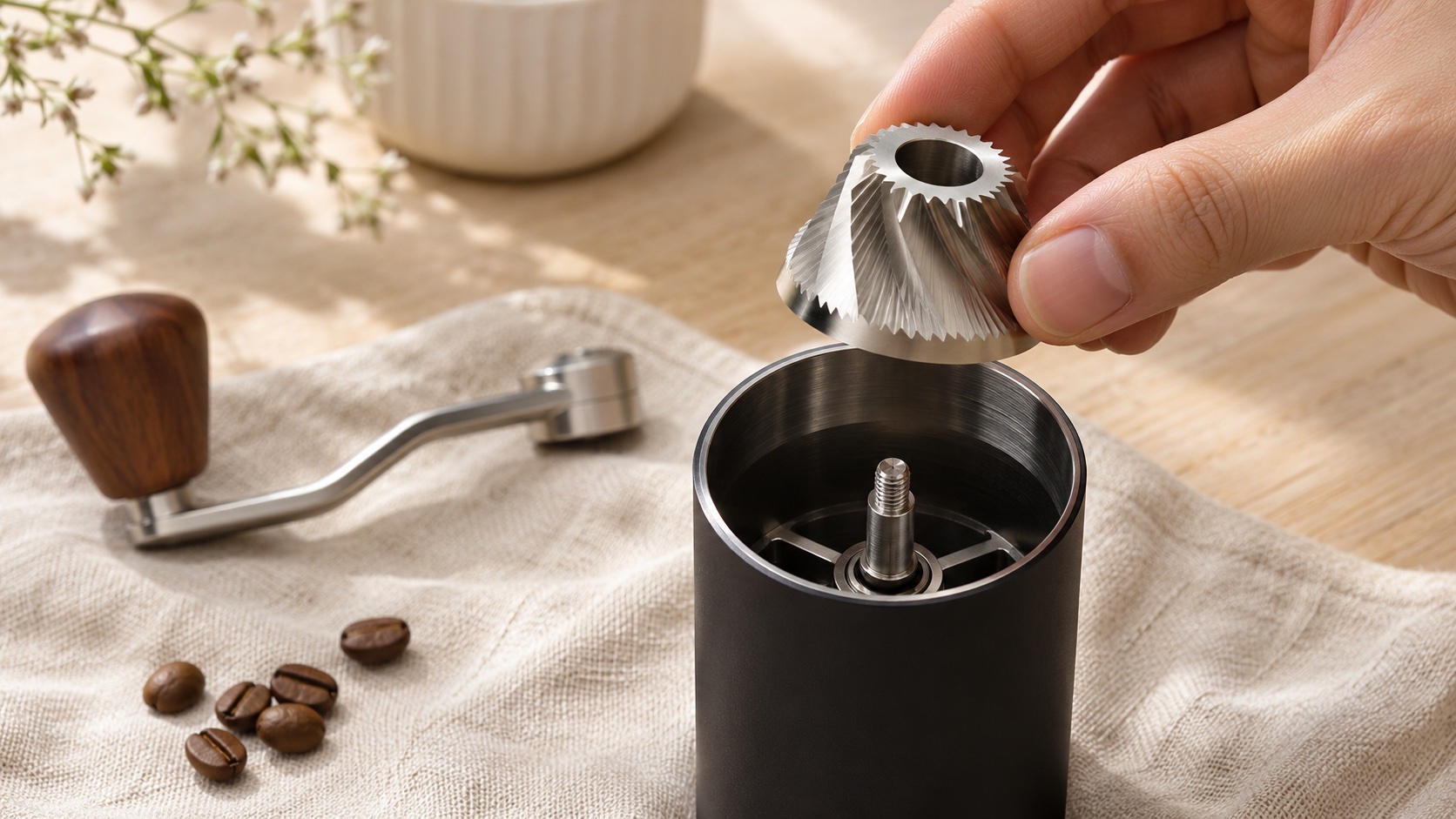
The main change from the C3 is the burr. TIMEMORE moved from the 38 mm S2C660 set to the new 42 mm S2C-042-III, a seven-sided “spike to cut” design. A larger burr shaves more coffee per turn, which is why it grinds a filter dose faster than the C3. The 42 mm burr is the largest in TIMEMORE’s C series.
The body is a one-piece aluminium shell. The Coffee Chronicler describes it as a rigid metal unibody with no internal plastic stabiliser, and Pull & Pour notes a steel central shaft held at both ends by bearings. That dual-bearing setup matters more than it sounds: it keeps the inner burr centred, so it wobbles less when you grind.
It is also a bigger grinder. The Coffee Chronicler puts the C5 at about 620 g against about 476 g for the C3, and TIMEMORE lists the Pro at about 640 g. Both the body and the handle are longer than the C3’s, which gives you more leverage but a little more bulk in a bag.
6. In Use, Day to Day
The dial
Adjustment is internal. You unscrew the catch cup, then turn a numbered dial under the burr. One rotation, numbered 0 to 15, covers the whole range, and each number has three clicks, so 48 clicks in total.
TIMEMORE’s own guide, repeated by Pull & Pour and Slow Pour Supply, sets out these starting points:
- Espresso and moka pot: 5 to 8 clicks
- Pour-over: 10 to 14 clicks
- French press: somewhere in the mid teens, with the two guides differing slightly
Treat those as a starting point, not a setting. The Coffee Chronicler found the printed ranges “feel off”: pour-over came out better at 15 to 17, and espresso on a 58 mm basket needed about 4 to 5. Burr zero points also vary from grinder to grinder. Our coffee grind size chart explains what to look for in the grounds while you dial in.
Speed
For filter, the bigger burr earns its keep. The Coffee Chronicler timed a 17 g pour-over dose at 48 seconds. Espresso is a different story: about 110 seconds for 17 g, which the reviewer called “painfully slow”. Pull & Pour also notes that the fine settings “take effort”.
Capacity and care
The catch cup tops out at about 22 to 25 g, even though the chamber can take more beans. TIMEMORE’s documentation says not to wash the grinder with water. Use the brush in the box. The same documentation warns that very light or single origin roasts are harder to grind by hand, which is true of every hand grinder but worth knowing at this burr size.
Retention and consistency
We could not find any published, independent measurement of retention (coffee left inside after grinding) or particle distribution for the C5 Pro as of 20 November 2026. Claims of “minimal retention” on retailer listings come without test data. Until someone measures it, treat it as unknown.
7. Results in the Cup
The best evidence available is The Coffee Chronicler’s blind taste test from November 2025, brewed as pour-over.
In the first round, against the older C3 and the Chestnut S3, the C5 produced “the most delicious cup”, the S3 was “fine but not as intense”, and the C3 was “clearly the worst”. That is a real result in the C5’s favour, and it supports the burr upgrade.
The second round is the honest counterweight. Brewed with a fruity anaerobic natural coffee and set against the S3 and a 1Zpresso Q Air, the C5 came last, with “a noticeably drying, astringent edge as it cooled”. The S3 won. The reviewer’s summary is that the C5 still “lacks some of the sparkle” of higher-tier burrs.
Read together: the C5 Pro is clearly better than the C3 in the cup, and competitive with the S3 on a forgiving coffee. On a delicate light roast, the S3’s burr pulls ahead.
8. TIMEMORE C5 Pro vs C3 vs S3
Prices are TIMEMORE’s own US store, checked 20 November 2026.
| Chestnut C3 | Chestnut C5 Pro | Chestnut S3 | |
|---|---|---|---|
| US price | From US$79 | US$110 | US$159 |
| Burr | 38 mm S2C660 | 42 mm S2C-042-III | 42 mm S2C890 |
| Dial | Internal, 12 clicks, 0.0833 mm per click | Internal, 48 clicks, 0.031 mm per click | External, 90 clicks, 0.015 mm per click |
| Best at | Budget filter | Filter, first serious grinder | Filter and occasional espresso |
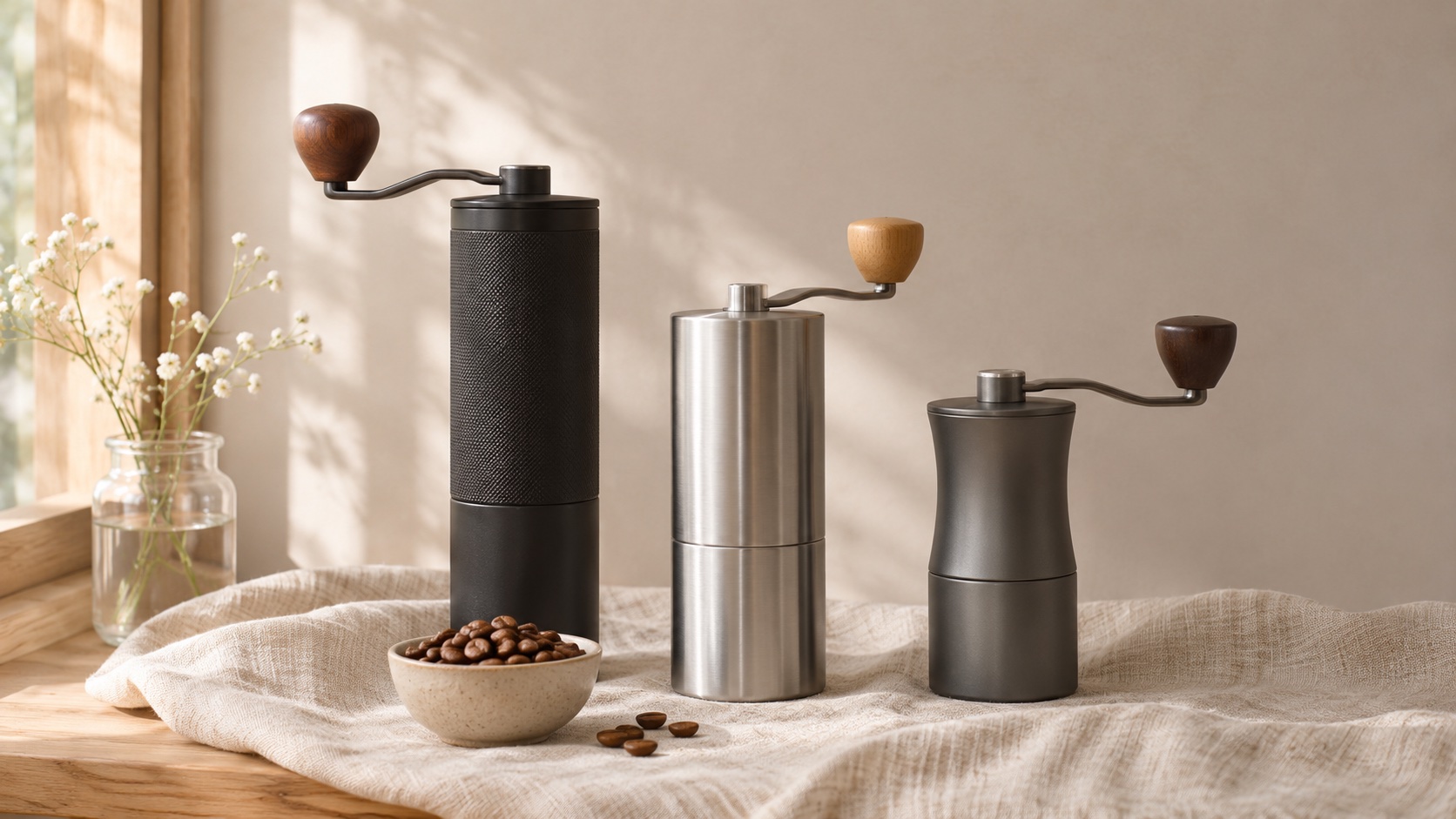
The C3 against the C5 Pro is straightforward. The C5 Pro has a larger burr, a finer and more usable dial, and an all-metal body for US$31 more. If you are choosing between the two new, choose the C5 Pro. Our older TIMEMORE C3 review still covers the C3’s strengths if budget is tight.
The S3 is harder. Its dial is outside the body, with steps half the size of the C5 Pro’s, and TIMEMORE calls it the brand’s first external adjustment ring. You change grind in seconds without touching the burrs. For US$49 more, you get a more precise grinder that is also easier to live with. Our TIMEMORE Chestnut S3 review goes through it in detail.
9. Where the C5 Pro Falls Short
- It is slow for espresso. About 110 seconds for a 17 g dose in independent testing, at a setting finer than the printed guide suggests
- The dial is internal. Every change means taking the catch cup off. Fine for one brew method, tedious if you switch
- The printed grind guide is optimistic. Expect to dial in by taste, not by the number in the box
- 25 g per load. One or two cups, not a pot
- “Pro” is mostly a handle. If you do not need it to fold, a plain C5 is the same grinder, so buy whichever is cheaper locally
- Price creep. Pull & Pour notes that “the price continues to creep upward with each generation”. The C5 Pro is US$31 above the C3’s starting price
10. Alternatives Worth Considering
Prices checked 20 November 2026 on TIMEMORE’s US store.
- TIMEMORE Chestnut S3, US$159. External adjustment, a finer 15 micron step and a folding handle. The better buy if you can afford it, and the one to choose if you might pull the occasional espresso
- TIMEMORE C5 ESP Pro, US$115. The same body and burr with a 15 micron dial and three rotations of range. Only US$5 more, and the version to buy if espresso is a real part of your routine
- TIMEMORE Chestnut C3s, US$89. The C3 with all-metal internals and the older 38 mm burr. Fine if US$110 is genuinely out of reach
- KINGrinder K7. An external dial, a magnetic catch cup and a pour-over first design. Read our KINGrinder K7 review for its settings and where it falls short. Prices vary by region, so check locally
And if you want one hand grinder that does espresso properly, step further up. Our TIMEMORE Chestnut S5 Pro review covers TIMEMORE’s 48 mm option, and why it is a home grinder, not a travel one.
11. Verdict: Is the TIMEMORE C5 Pro Worth It?
Yes, for the right person. If you brew filter coffee, want your first proper hand grinder, and have about US$110, the C5 Pro is a real step up from the C3: a bigger burr, a finer dial, a metal body and a handle that folds.
Buy the S3 instead if you can find US$49 more, because its external dial is a quality-of-life change you notice every day. Buy the C5 ESP Pro if espresso matters, since it costs US$5 more. And if you do not care whether the handle folds, buy the plain C5 wherever it is cheaper.
FAQ
Is the TIMEMORE C5 Pro good for espresso?
Not really. It can reach espresso fineness, but each click is 0.031 mm, which is coarse for dialling in a shot, and independent testing timed about 110 seconds to grind 17 g. For espresso, buy the C5 ESP Pro or the Chestnut S3.
What is the difference between the TIMEMORE C5 and C5 Pro?
Only the handle. The C5 Pro has a folding handle, while the C5’s is fixed. The burr, body and 48 click dial are the same, so they grind the same.
How many grind settings does the TIMEMORE C5 Pro have?
48 clicks in one rotation, numbered 0 to 15 with three clicks per number. TIMEMORE’s guide puts espresso at 5 to 8 clicks and pour-over at 10 to 14, though one independent reviewer found pour-over better at 15 to 17.
Is the C5 Pro better than the C3?
Yes. It has a 42 mm burr instead of 38 mm, a finer 48 click dial instead of 12, and an all-metal body. In one blind pour-over test, the C5 clearly beat the C3. It costs US$110 against the C3’s US$79 starting price.
Should I buy the C5 Pro or the Chestnut S3?
Buy the S3 if your budget reaches US$159. It has an external dial with a 15 micron step, so it is quicker to adjust and better for the occasional espresso. Buy the C5 Pro if US$110 is your limit and you brew filter.
How much coffee does the TIMEMORE C5 Pro hold?
The catch cup holds about 25 g of ground coffee, enough for one or two cups. The grind chamber can take around 30 g of beans, but the catch cup is the real limit.
Disclosure
Note: Some links on La Milan Cafe may earn us a commission at no extra cost to you, which helps support the work. Brewing involves hot water and, for some methods, pressure or electrical appliances — always follow the manufacturer’s instructions.
No Comments