

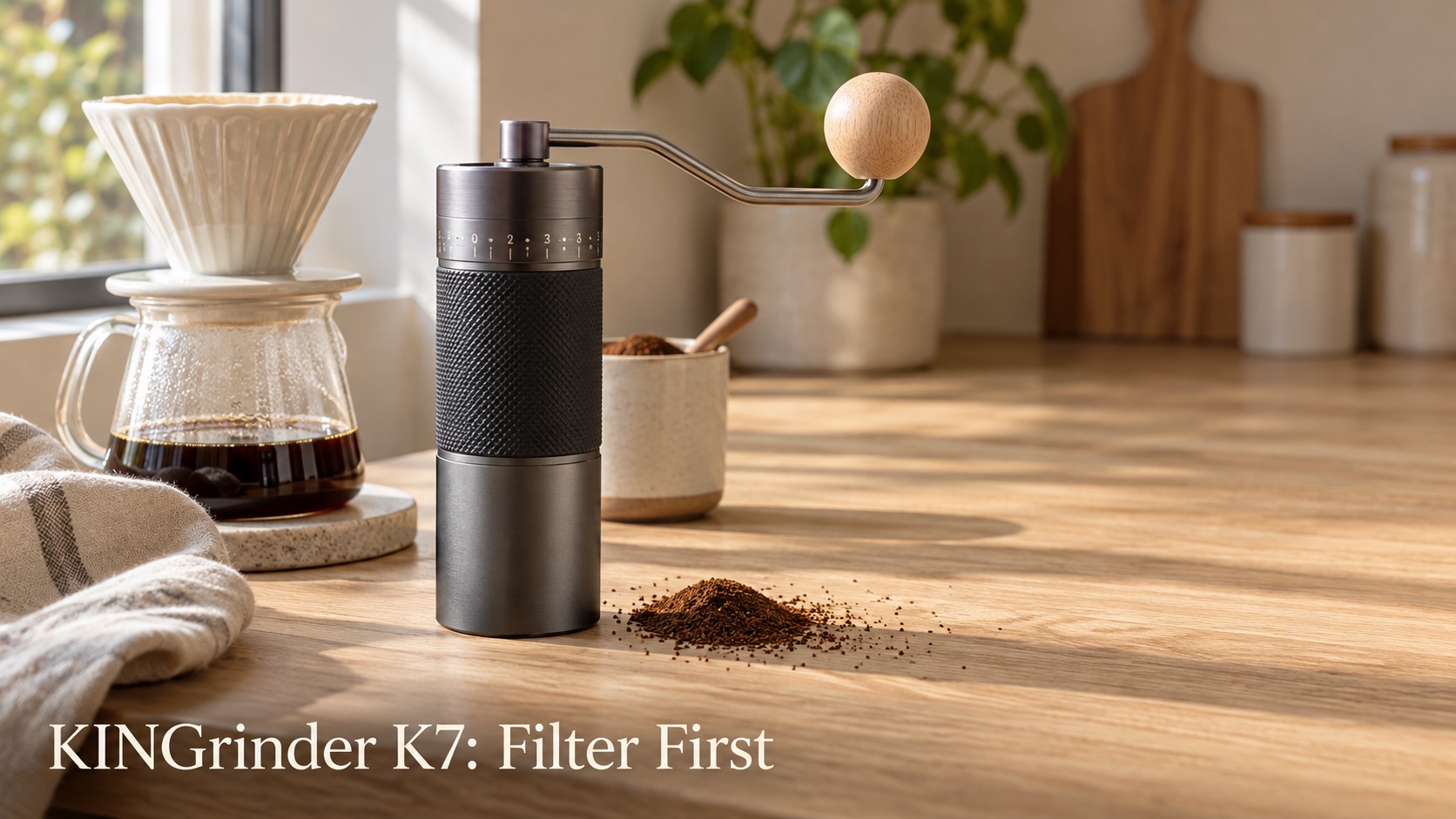
KINGrinder K7 Review: A Filter Grinder, Not a K6 Upgrade
1. The KINGrinder K7 Verdict, in Two Sentences
The KINGrinder K7 is a pour-over first hand grinder with a finer 100 click dial, a magnetic catch cup and a grippier sleeve, and at S$179 in Singapore it makes sense for a filter brewer buying their first serious hand grinder. It is not a reason to retire a working K6, it is not the clearest filter grinder at its price band, and if espresso is your main drink there are better tools for the job.
This is a specification-led review. We have not had a K7 on our own counter, so everything below comes from KINGrinder’s product page and English manual, the Singapore retailer listing, and two independent reviewers who did use one. Where a figure comes from a reviewer rather than the maker, we say so.
2. KINGrinder K7 Specifications at a Glance
Specs and prices checked 29 October 2026 on KINGrinder’s official K7 page and English manual, and on Watch & Puck’s Singapore store. Models and pricing change without notice.
| Specification | KINGrinder K7 |
|---|---|
| Type | Manual (hand) conical burr grinder |
| Burr | “7-edge large burr design”, stainless steel (KINGrinder) |
| Burr diameter | Not published by KINGrinder |
| Adjustment | External ring, 100 clicks per full rotation |
| Step size | 15 microns per click, per two independent reviewers |
| Lowest safe setting | 15 clicks (manual) |
| Bean capacity | About 30 to 35 g, per two independent reviewers |
| Body | Aluminium, with a textured silicone grip sleeve |
| Catch cup | Magnetic, with a clip-on lock |
| In the box | Grinder, handle and plastic lid, spare black O-ring, quick guide, brush |
| Drill use | Supported with a 1/4 inch hex bit, at low speed (manual) |
| Singapore price | S$179, in stock at Watch & Puck |
| K6 in Singapore | S$129, in stock at the same store |
Three things are missing from that table on purpose. KINGrinder does not publish the K7’s burr diameter, and the figures quoted elsewhere disagree with each other, so we are not going to pick one. We also could not find a documented weight, warranty term or country of manufacture from KINGrinder itself. Ask the retailer about warranty before you pay.
3. Who the KINGrinder K7 Is For, and Who It Is Not
The K7 suits you if:
- You brew pour-over most mornings and want a hand grinder that will last
- You like small, precise adjustments when you are chasing a recipe
- You want espresso available as an occasional option rather than the main event
- You are buying your first KINGrinder and the S$50 gap over the K6 does not bother you
It is not for you if:
- You already own a K6 that works. The two are sold side by side, not as old and new versions
- Espresso is your daily drink. You will want a grinder built around espresso first
- You want the cleanest, most separated filter cup this kind of money buys
- You hate recalibrating. The zero point on this grinder drifts, and the manual says so
4. Build and Design
KINGrinder’s own product page is brief. It describes a “7-edge large burr design” for “significantly improved grinding efficiency”, precision-cut burrs for “consistent particle size”, and a grinder “designed for advanced pour-over coffee enthusiasts, while also compatible with espresso brewing.” Those are the manufacturer’s words. Nobody has published particle size measurements for the K7 that would confirm or contradict them.
The physical changes are easier to pin down:
- The catch cup is held by a magnet and a clip-on lock. KINGrinder describes it as a “Magnetic + Locking Design Powder Receiver”
- The grip is an upgraded silicone sleeve with a textured, anti-slip surface
- The body is aluminium, according to both independent reviewers
- The dial sits at the top of the body, outside, so you change grind without taking anything apart
The catch cup is the part reviewers have opinions about. 9bar Benchmark, which bought its own unit, found it could shift under a little finger while grinding, though it never came off. Coffee Chronicler, writing after close to four months of use, noted some early play in the bayonet fitting. Neither is a deal breaker, but neither is the rock-solid feel the “locking” label suggests.
5. In Use, Day to Day
K7 grind settings and the zero point
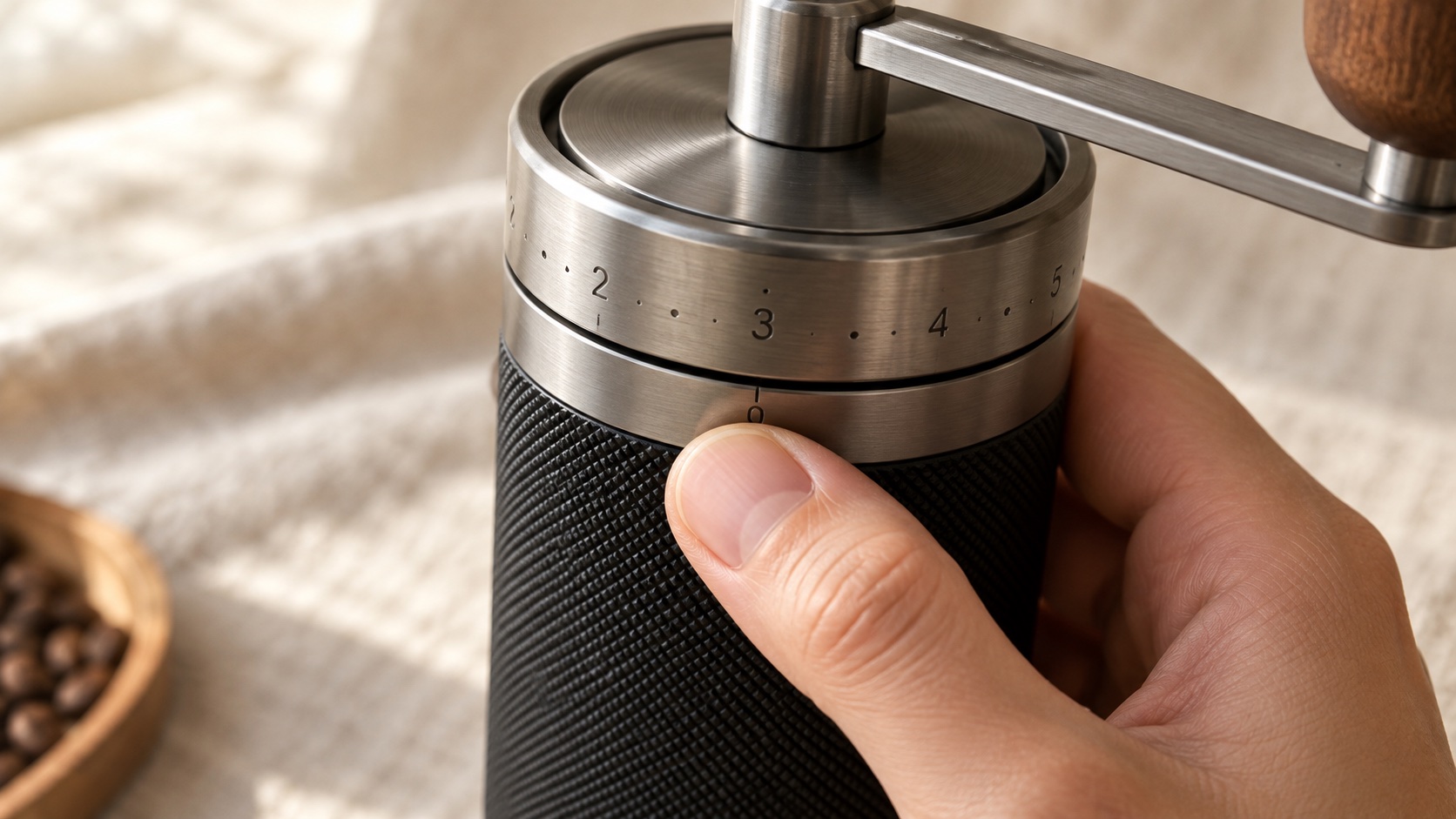
The K7 counts clicks up from a zero point that you set yourself. The manual’s routine: turn the adjustment nut anticlockwise gently until it stops, rotate the zero point nut so it lines up with zero, then turn clockwise to your setting. One full turn is 100 clicks.
KINGrinder’s recommended starting points, straight from the K7 manual:
- Turkish coffee: 20 to 30 clicks
- Espresso: 30 to 40 clicks
- Moka pot and AeroPress: 40 to 50 clicks
- Pour-over: 60 to 80 clicks
- French press: 80 to 100 clicks
The manual is firm on one point: do not grind below 15 clicks, and do not turn the handle at zero, because that can damage the burr set. It also says, twice, that the zero point nut shifting after grinding is normal and that you simply realign it.
That drift is the K7’s most repeated complaint. Coffee Chronicler blames the rubber sleeve and estimated around three clicks of drift per session. 9bar Benchmark also found the dial could be nudged by accident. On a 100 click dial, three clicks will not ruin a pour-over, but it will move an espresso shot, so build a quick zero check into your routine.
Cleaning and care
KINGrinder’s rules for the K7 are specific, and stricter than some owners expect:
- No water. The manual says the grinder “should not be washed with water”. Use the supplied brush or an air blower
- Clean at least monthly. It asks for a full disassembly and clean at intervals of no more than 30 days
- Disassembly starts by turning the adjustment to its coarsest end stop, then pushing up on the burr while holding it still and lining up the hexagonal shaft with the dot on the fastener. You do not need to remove the adjustment nut
- Do not remove the outer burr. KINGrinder says this is for precision reasons
- RDT is fine, but not on the grinder. RDT (a light mist of water on the beans to cut static) should be done by spraying the beans in a separate container, never the grinder itself
- No regrinding of grounds, and no green, unroasted beans
The manual also allows grinding with a cordless screwdriver fitted with a 1/4 inch hex bit, with the handle removed and the spare black O-ring fitted to the lid, as long as you keep the speed low to protect the shaft. Use only one O-ring at a time; fitting both causes abnormal noise, by KINGrinder’s own warning.
Espresso in practice
The K7 can grind for espresso, and both reviewers pulled shots with it. 9bar Benchmark found 35 clicks too fine and 40 too fast for a medium espresso roast, and settled on 38 to 39. Coffee Chronicler suggests starting around 35 and warns that the grinder “can easily choke a machine if you go too fine.” Neither published a timed grind for an espresso dose, so we will not guess at one.
6. Results in the Cup
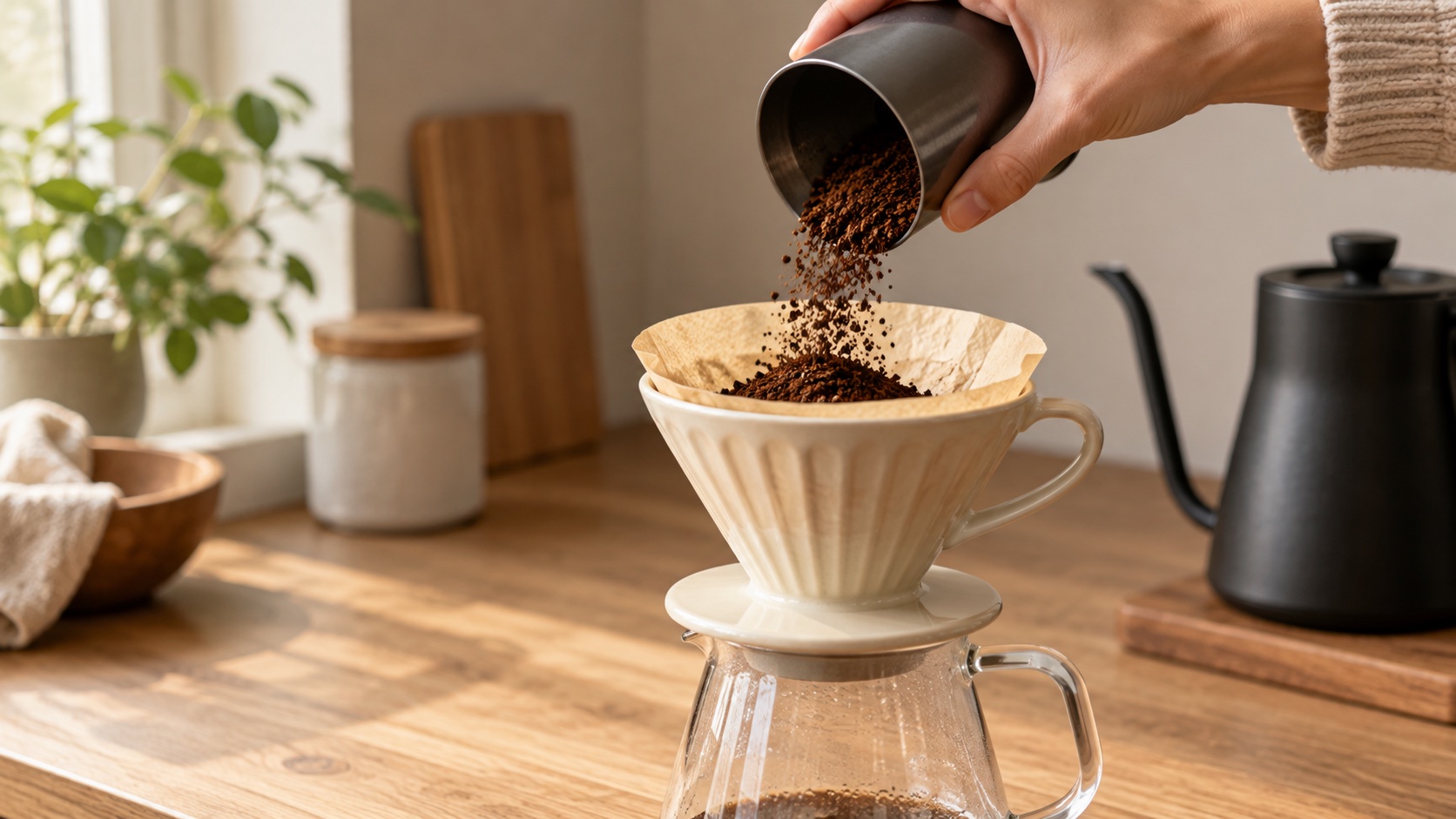
KINGrinder positions the K7 for filter clarity. Independent impressions are more nuanced.
- Coffee Chronicler found the K7’s filter cups softer and more diffuse than a 1Zpresso ZP6’s sharper, clearer profile, with a mid-palate focus. It called espresso fine but average, noted a slight drying aftertaste at finer settings, and said the K7 is not a ZP6 replacement
- 9bar Benchmark got “a pretty nice shot” at 40 clicks that ran a little fast, said it was “really happy with the tastes”, and measured retention (grounds left inside after a dose) at net zero
Put together, the K7 reads as a competent, comfortable filter grinder rather than one that redefines clarity at its price. That is a respectable place to be. It is just not quite what the marketing implies.
7. KINGrinder K7 vs K6: Should You Upgrade?
The short answer for a K6 owner is no, unless a specific K6 habit annoys you.
| KINGrinder K7 | KINGrinder K6 | |
|---|---|---|
| Burr | 7-edge design, diameter unpublished | 48 mm heptagonal |
| Clicks per rotation | 100 | 60 |
| Step per click | 15 microns (reviewers) | 16 microns |
| Catch cup | Magnetic with clip-on lock | Screw-on |
| Singapore price | S$179 | S$129 |
Two points stand out. First, the step size barely moves: 15 microns against 16. The finer feel of the K7 comes mostly from more clicks per turn, not from much smaller steps, so a K6 user already has nearly the same resolution. Second, KINGrinder still lists the K6 manual next to the K7’s, and Watch & Puck sells both in the same listing, describing the K6 as the all-rounder and the K7 as the filter specialist. The K7 is a sibling, not a successor.
Where the K7 does improve on the K6 is handling: the magnetic catch cup instead of a screw-on one, the grippier sleeve, and, according to Coffee Chronicler, easier reassembly than the K6’s clip-held design.
8. Where It Falls Short
Skip the K7 if:
- You own a K6. The step size is almost identical, and you would be paying S$179 for a nicer catch cup and grip
- Espresso is your priority. It works, but both reviewers describe espresso as acceptable rather than special, and the K6 costs S$50 less for an all-rounder
- You want the clearest pour-over. In Coffee Chronicler’s side-by-side, the ZP6 was the sharper, clearer cup
- You want set-and-forget. Zero point drift is documented by the manual and by both reviewers
- You rinse your gear. No water on the grinder at all, and a full strip-down clean at least every 30 days
A smaller irritation: 9bar Benchmark noted typos and grammatical errors in the setup guide. We saw the same thing in the English PDF, which is labelled “MODLE: K7” on its cover. It does not change the grinder, but read the manual carefully rather than skimming it.
9. Alternatives Worth Considering
Prices checked 29 October 2026.
- KINGrinder K6, S$129 at Watch & Puck. The better buy for most people. A 48 mm heptagonal burr, 60 clicks per turn at 16 microns, and the stronger case if you split your week between espresso and filter.
- 1Zpresso ZP6 Special, US$209 on 1Zpresso’s own store. 1Zpresso says it is “primarily designed for pour-overs”, and in the one head-to-head we found it gave the clearer filter cup. Do not buy it for espresso. That US price is not a Singapore price; check local stock and add shipping and GST.
- Something heavier and espresso capable. If you want one hand grinder that handles shots and pour-over with more body, read our TIMEMORE Chestnut S5 Pro review, or our 1Zpresso K-Ultra review for an all-rounder with a longer track record. Their prices were checked separately and may have moved.
10. Verdict: Is the KINGrinder K7 Worth It?
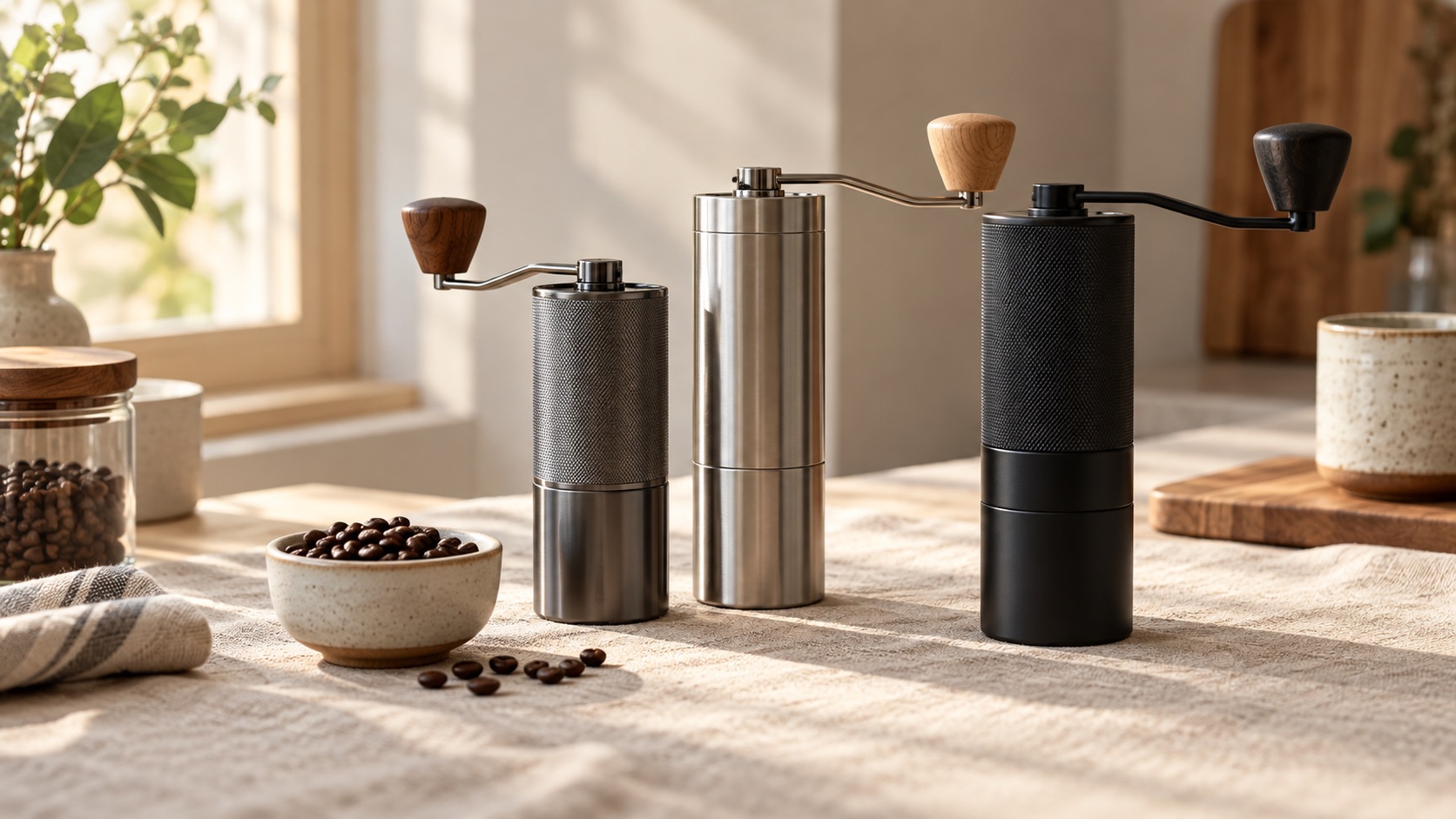
Buy the KINGrinder K7 at S$179 if you brew mostly pour-over, do not yet own a good hand grinder, and value the magnetic catch cup and finer-feeling dial enough to pay S$50 over the K6. For that reader, it is a comfortable, capable filter grinder that can still pull the odd espresso.
If you split your coffee between espresso and filter, buy the K6 at S$129 instead. If clarity on light roasts is the whole point, look at the 1Zpresso ZP6 Special. And if you already own a K6, keep it: the K7’s improvements are about handling, not a meaningfully finer grind.
Before you set your first recipe, our guide to choosing the right coffee grind size explains what each step on that dial changes in the cup, and our hand brew guide puts it to work.
FAQ
Is the KINGrinder K7 good for espresso?
It can grind for espresso, and KINGrinder’s manual suggests 30 to 40 clicks. One independent reviewer settled on 38 to 39 clicks for a medium roast, while another described the espresso as fine but average. It is a filter-first grinder that handles espresso, not an espresso specialist.
What are the best K7 grind settings for pour-over?
KINGrinder’s manual suggests 60 to 80 clicks from zero for pour-over. Start in the middle, around 70, then go finer if the cup tastes thin or sour and coarser if it tastes bitter or drains slowly. Recheck your zero point regularly, because it can drift.
What is the difference between the KINGrinder K7 and K6?
The K7 has 100 clicks per rotation against the K6’s 60, a magnetic and clip-on catch cup instead of a screw-on one, and an upgraded silicone grip. The step per click is almost the same, 15 microns against 16. In Singapore the K7 is S$179 and the K6 S$129.
Can you wash the KINGrinder K7 with water?
No. KINGrinder’s manual says the grinder should not be washed with water and asks you not to spray water directly onto any part of it. Clean it with the supplied brush or an air blower, with a full disassembly at least every 30 days.
Why does my K7 zero point keep moving?
KINGrinder says it is normal for the zero point nut to shift after grinding. To reset it, turn the adjustment nut anticlockwise gently until it stops, then line the zero point nut up with zero again. One reviewer linked the drift to the rubber grip sleeve.
Is the KINGrinder K7 available in Singapore?
Yes. As of 29 October 2026, Watch & Puck listed the K7 at S$179 and in stock, alongside the K6 at S$129. Check warranty terms with the retailer before you buy, because we could not find them documented by KINGrinder.
Disclosure
Note: Some links on La Milan Cafe may earn us a commission at no extra cost to you, which helps support the work. Brewing involves hot water and, for some methods, pressure or electrical appliances — always follow the manufacturer’s instructions.
No Comments