

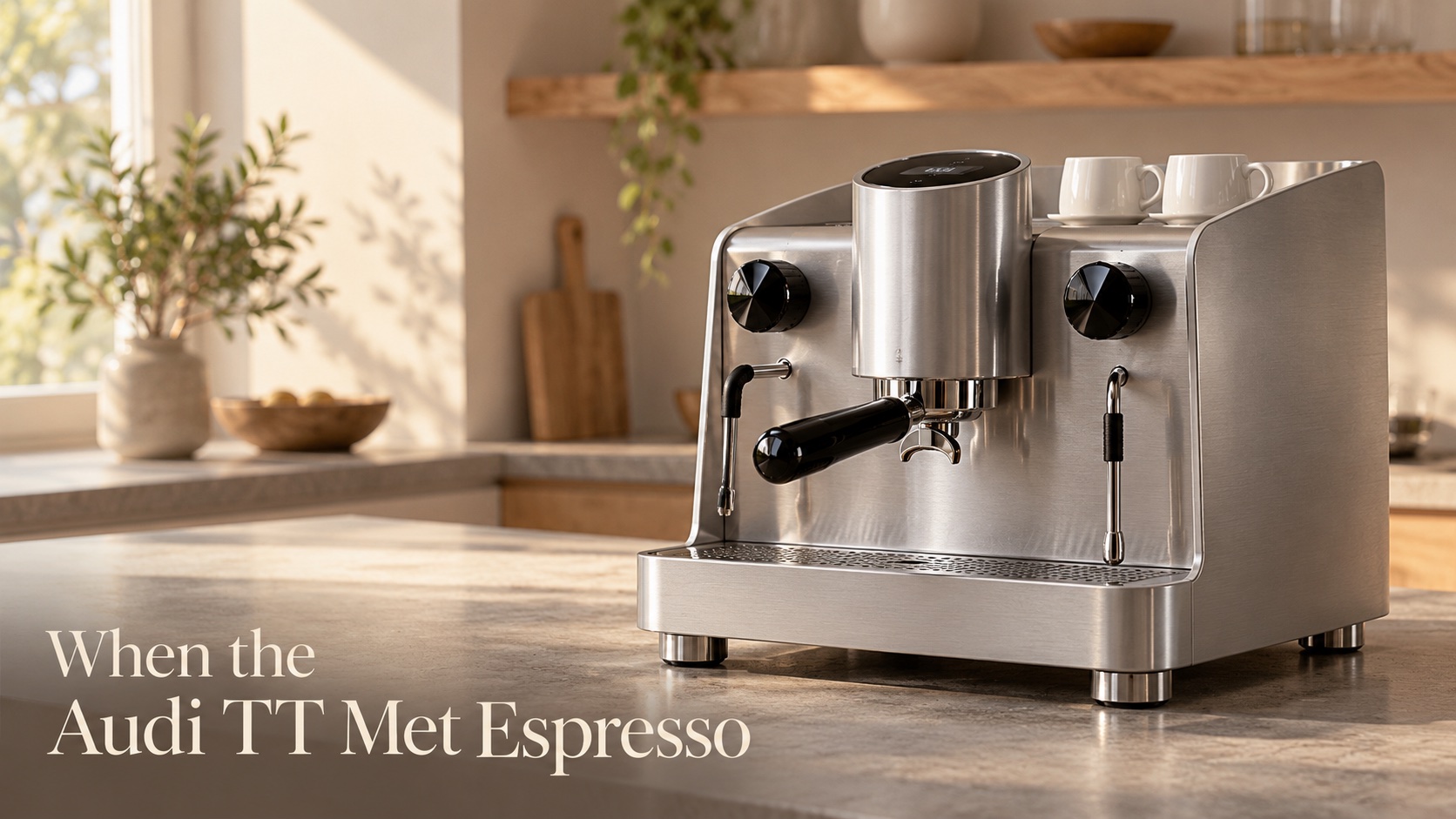
How the Audi TT Shaped the Rocket x Audi Espresso Machine
How the Audi TT Shaped the Rocket x Audi Espresso Machine
Picture the first Audi TT parked at the kerb. It is mostly circles: round wheel arches that seem to have been pressed into the body, a roofline that is one long, unbroken arc. Now picture an espresso machine on a kitchen counter, a box of polished steel with two chrome levers and a pressure gauge. The two objects could hardly be further apart.
In September 2026, Rocket Espresso, a Milan maker of hand assembled espresso machines, announced a machine that tries to close that gap. It is called Rocket x Audi, and it was drawn with the help of Audi’s own design team, with the first generation TT as its reference point.
This is not a review. Nobody at La Milan Cafe has pulled a shot on one. It is the story of how the machine came to exist, what the designers carried across from the car, and the more useful question underneath it all: which parts of the Rocket x Audi espresso machine change what ends up in your cup, and which parts change only how the corner of your kitchen looks.
A Milan Workshop and a Car Company
Rocket Espresso was founded in Milan in 2007 by Andrew Meo, a New Zealander, and Daniele Berenbruch, an Italian. The company builds espresso machines for homes and for cafes, and every one is still assembled by hand in Milan. Its home machines sit in what the trade calls the prosumer bracket: machines built to professional standards but sized for a kitchen, bought by people who take their morning shot very seriously.
The new machine is not a car company’s coffee maker, and it is worth being precise about that. Rocket builds it, on the body of one of its own existing models. Audi’s part is the design. Rocket’s announcement describes a cooperation supported by the Audi Design Team, and the design work itself was led by an outside studio in Milan, Valerio Cometti + V12 Design, working alongside Audi’s designers.
That studio is not a stranger to espresso. Valerio Cometti trained as a mechanical engineer at the Politecnico di Milano and has been the designer behind LaCimbali and Faema machines since 2008, two of the best known names in Italian cafe equipment. When a car maker’s design language needed translating into a coffee machine, it went to someone who already knew where the boilers, the pump and the plumbing have to go.
Neither company has published a business reason for the partnership, and this article will not invent one. What can be said is that both firms trade on the same idea: that a machine made with care should also look like it was made with care.
The Car That Became a Design Brief
The Audi TT began as a concept car shown at the Frankfurt Motor Show in 1995, credited to designers J Mays and Freeman Thomas. It went into production in 1998 as a coupe, with a roadster following in 1999, and that first generation ran until 2006. Audi’s own head of design, Marc Lichte, has described the shape of the first TT as inspired by the Bauhaus, the German design school that taught that form should follow function and that decoration should earn its place.
The car stayed in production for three generations. The last TT was built in November 2023, after more than 660,000 had been made. For a whole generation of designers it remained the clearest example of what Audi design was supposed to mean: few lines, each one deliberate.
V12 Design’s own project page names a second reference alongside the first generation TT: the Audi Avus quattro, a concept car shown at the Tokyo Motor Show in 1991. The Avus is remembered for its bare, polished aluminium body, a nod to the silver Auto Union racing cars of the 1930s. It was a show car, not a running one; the engine in the display car was a dummy. What it gave Audi was a look: raw aluminium, worn proudly, with nothing painted over it.
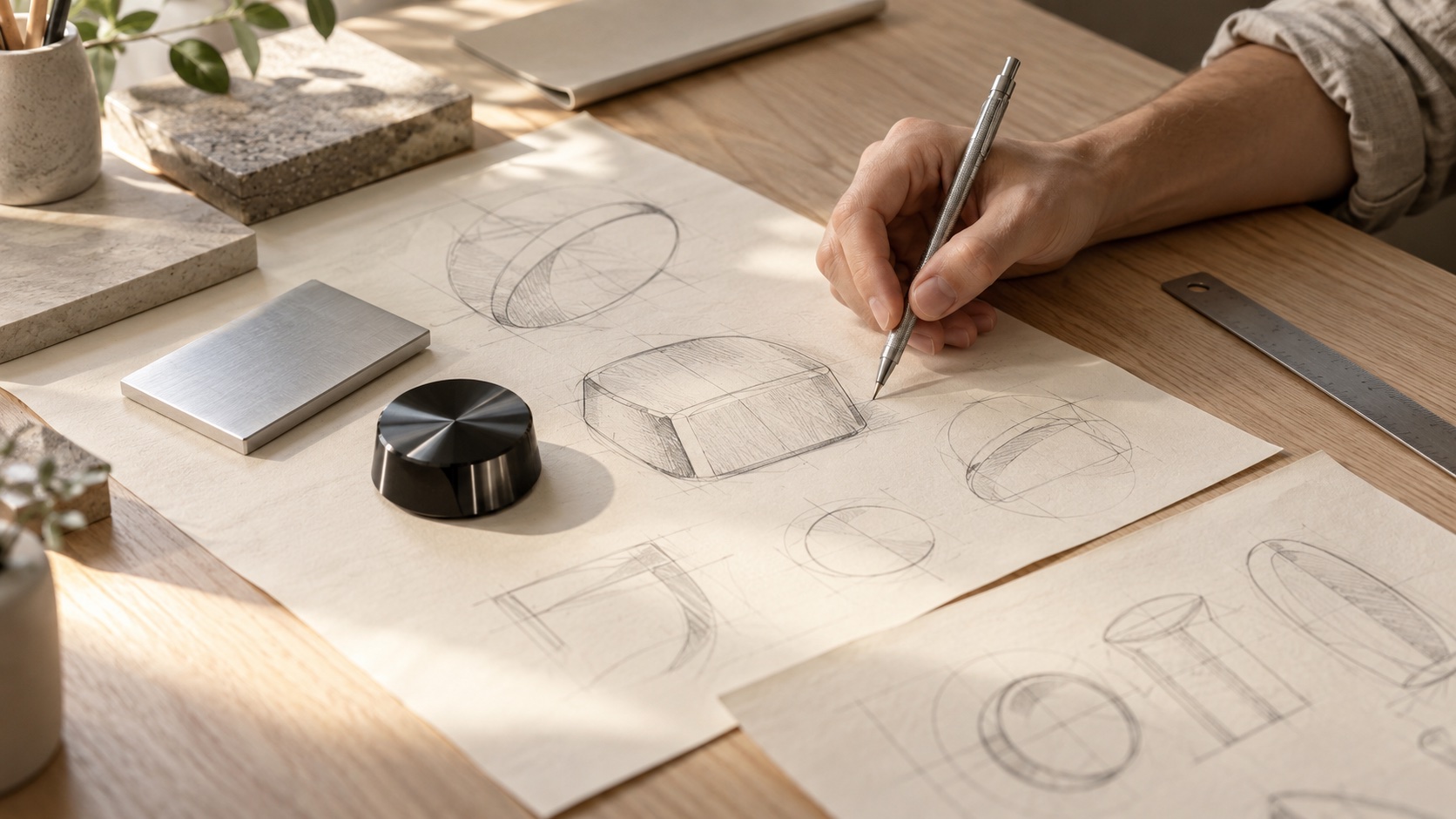
Put the two cars side by side and you have most of the machine’s brief. From the TT came the geometry, the circles and the soft radii where one surface turns into another. From the Avus came the idea of bare aluminium as the finish rather than something hidden underneath.
What the Designers Carried Across
The finished machine wears matte aluminium almost everywhere. Against it, the portafilter handle and the rotary controls are a glossy black, a finish V12 Design describes as developed for this project. A few hard black accents are what make the metal read as metal.
The side panels do not stop at a flat edge. They rise gradually towards the back of the machine and curve over, so the top becomes a tray with a raised border, the place where you warm your cups. On most espresso machines the cup tray is a rail bolted onto a box. Here it is part of the shape of the body.
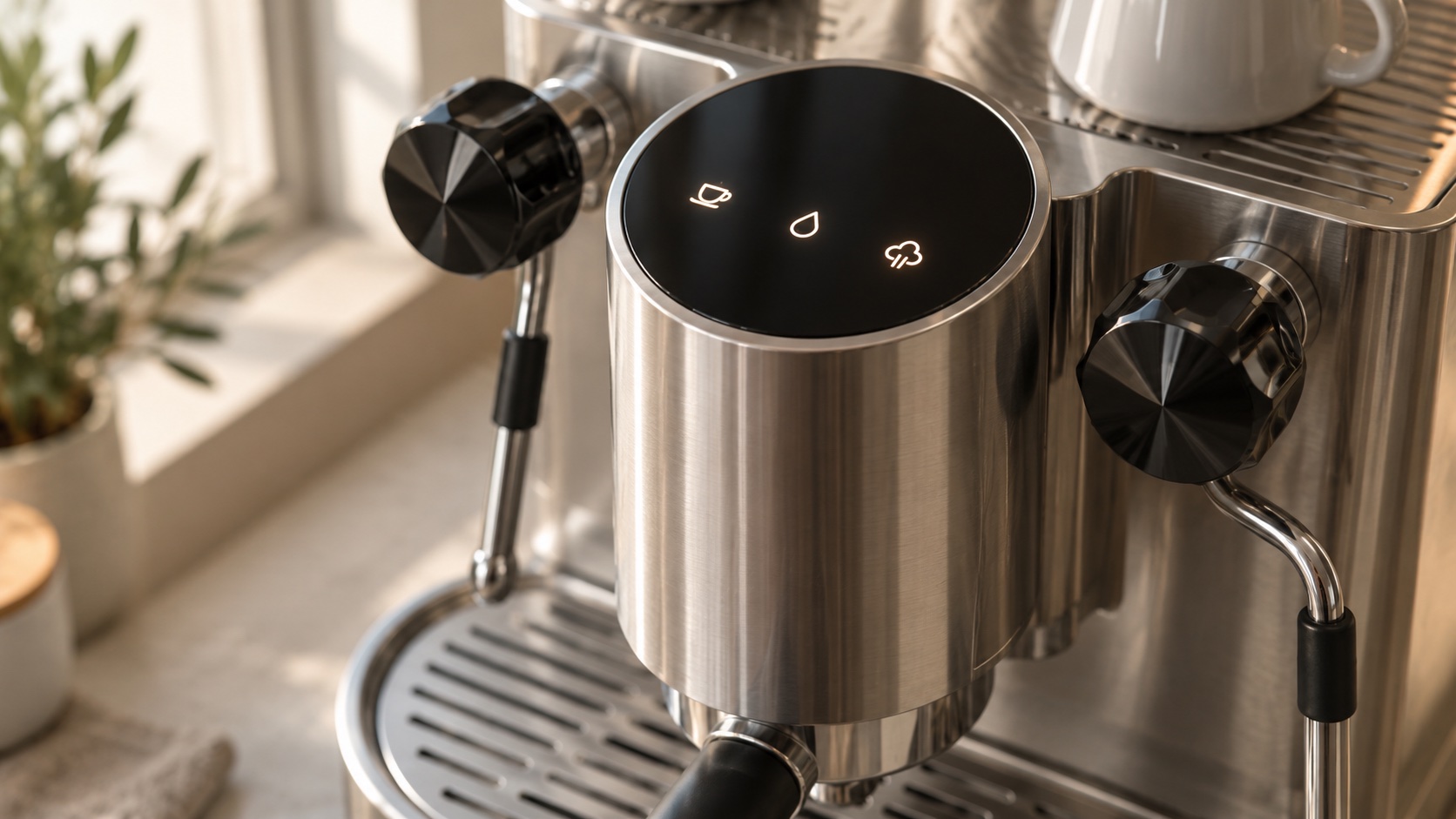
At the centre sits the brew group, the part that holds the portafilter and delivers water to the coffee. On this machine it is a single upright cylinder of brushed aluminium, set into the housing instead of hanging off the front. On top of that cylinder, facing up at whoever is standing at the counter, is a 3.5 inch touch display. It uses symbols rather than words, and V12 Design says its colours were customised for Audi.
Underneath, the machine stands on four round aluminium feet that lift the body off the counter, so it appears to hover slightly. Rocket’s own product text uses almost the same image. It is the kind of detail that changes nothing about the coffee and quite a lot about how the object sits in a room.
The Bicocca Underneath
Strip away the aluminium and you find a machine Rocket already sold: the Bicocca, a dual boiler model near the top of its home range. Rocket’s specifications for the Audi version, checked in October 2026, read like a serious home espresso machine rather than a styling exercise.
- Two stainless steel boilers: a 0.5 litre boiler for brewing coffee and a separate 1.5 litre boiler for steam and hot water, both insulated to save energy
- Rotary pump: quieter and steadier than the vibration pumps used in most entry level machines
- PID temperature control on an electrically heated brew group
- Water: a 1.8 litre tank with a low water sensor, or a direct connection to the mains water supply
- Power and size: 1,600 W, in 220 to 240 V and 115 V versions; 409 mm wide, 465 mm deep, 400 mm tall, and 35 kg
A few of those terms deserve a plain explanation. Two boilers mean the machine can hold brewing water at one temperature and steam at a much hotter one, at the same time. On a single boiler machine you brew, then wait for the boiler to heat up before you can steam milk. With two, you can pull a shot and texture milk side by side.
PID is short for proportional integral derivative, the name of the control method. In practice it means a small computer manages the heating instead of a simple on and off thermostat, so the brewing water holds much closer to the temperature you set. That matters because espresso is sensitive to temperature: a couple of degrees can tip a shot from sweet to sour or from rich to bitter.
Rocket also designed a matching grinder, the Spluga x Audi, dressed in the same aluminium and black. Mechanically it is Rocket’s existing Spluga grinder, with 65 mm flat steel burrs, a 480 W motor and a 500 g bean hopper.
Where the Design Meets the Cup
This is the part worth being honest about, because it is easy to blur. The Audi side of this machine changes the way it looks, the way it sits in a room and the way you interact with it. It does not change the espresso. The things that decide what you taste, the boilers, the pump, the temperature control, belong to the Bicocca, and the Bicocca was already a capable machine before Audi’s designers touched it.
Some of the design does reach the ritual, if not the cup. The raised side panels give your cups a proper place to warm before the shot. A touch display at the top of the group puts the information where your eyes already are while the shot runs, rather than on a panel at knee height. Those are real, small comforts. They are not reasons the coffee will taste different.
And no machine, at any price, can do the work that happens before the portafilter is locked in. The grind is still the biggest single variable in espresso: too fine and the shot chokes and tastes harsh, too coarse and it gushes through thin and sour. Our guide to choosing the right grind size explains why. Fresh, well roasted beans matter just as much, and our piece on the best coffee beans for espresso covers what to look for on the bag. Water, technique and regular cleaning finish the list. A beautiful machine in the hands of a careless routine still makes a careless shot.
What It Costs, and Where You Can Buy One
Rocket’s UK store lists the Rocket x Audi Special Edition at £5,750 including tax, sold by preorder with a lead time of roughly four to six weeks, checked on 15 October 2026. The same store lists a bundle with the matching grinder separately. Rocket calls the machine a Special Edition, but its product page makes no claim about a limited production run or numbered units. Its UK warranty covers two years for parts and one year for labour, for domestic customers.
For context, a UK specialist retailer listed the standard stainless Bicocca at £3,900 including VAT on the same date. Taking those two prices together, the design costs about £1,850 on top of the machine it is built on. Whether that is worth paying is a question of taste, and only the buyer can answer it.
Availability elsewhere is less clear. Rocket lists a 115 V version, the voltage used in North America, but this article could not confirm official pricing or distribution in Singapore or the United States. Prices, stock and lead times change, so check with Rocket or an authorised local dealer, and ask who services the machine where you live, before ordering.
The Same Coffee, a Different Room
The interesting thing about this machine is not that a car brand put its name on a coffee maker. That happens often, and usually means a logo on a box. It is that a design language built for something you drive, with its circles, its bare aluminium and its few deliberate lines, was handed to a studio that knows espresso machines from the inside, and fitted over a machine that already did its job well.

If you want to see how a design led machine compares with one built purely for the shot, our SMEG ECF03 review looks at another machine where looks are part of the purchase, and our Gaggia Classic Evo Pro review sits at the opposite end, a plain machine loved for what it does. Rocket’s own Rocket x Audi page has the full specifications.
Next time you pull a shot, on whatever machine you own, look at it for a moment before you start. Notice which parts of it are there for the coffee and which are there for you. On the Rocket x Audi, the line between the two has simply been drawn by people who spent their careers thinking about cars.
Note: Brewing involves hot water and, for some methods, pressure or electrical appliances — always follow the manufacturer’s instructions.
No Comments