

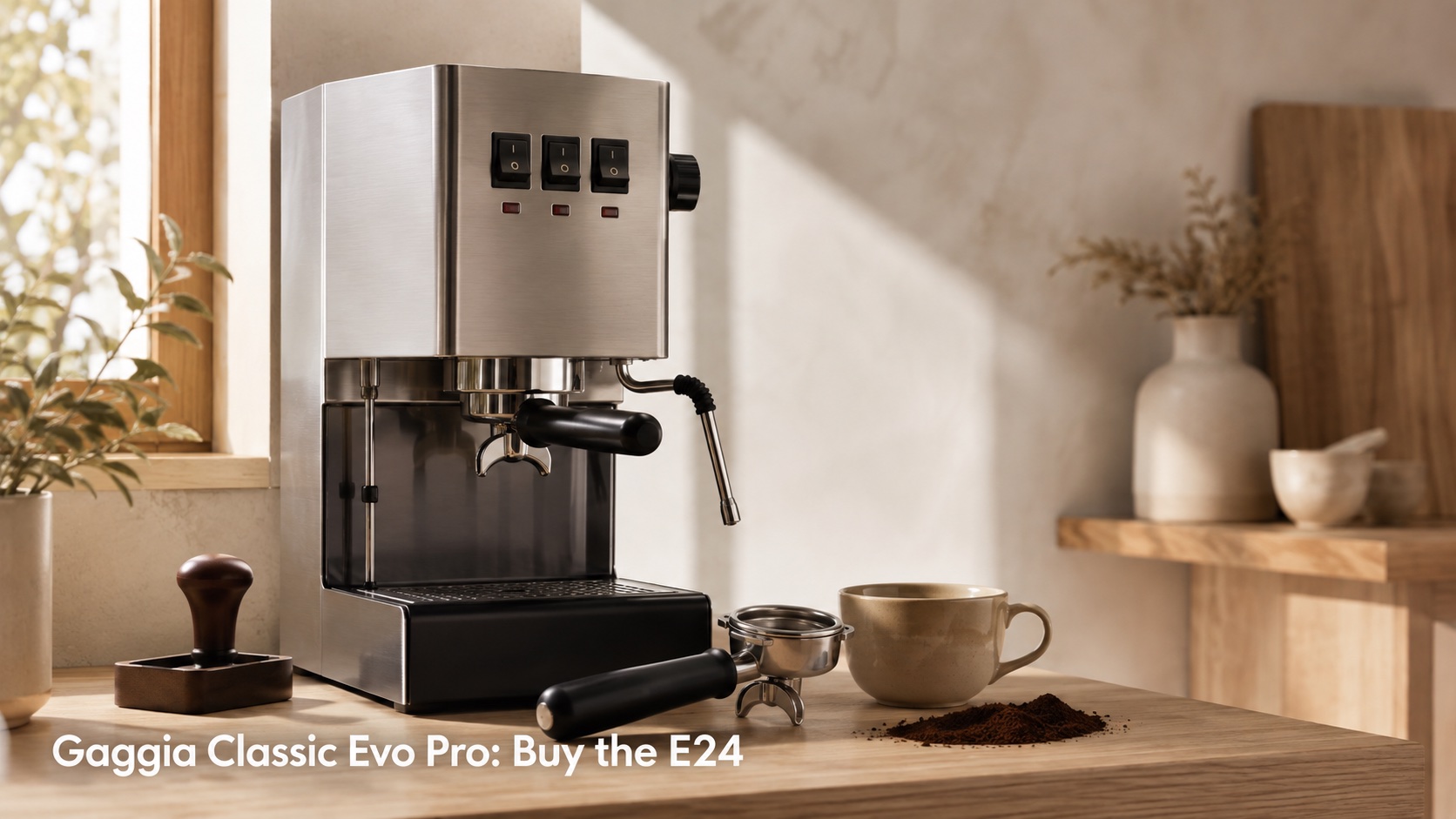
Gaggia Classic Evo Pro Review: Buy the E24, Not the Old One
Gaggia Classic Evo Pro Review: Buy the E24, Not the Old One
Buy it, but buy the current version. The Gaggia Classic Evo Pro you may have read about in 2023 and 2024 shipped with a coated aluminium boiler that failed badly enough to earn its own nickname, and the machine sold today under the name Gaggia Classic Pro E24 replaces that boiler with solid brass, which is the single reason this review ends in a recommendation rather than a warning.
That distinction is the most important thing on this page. If you are shopping secondhand, or reading an older round-up, you can easily end up with the wrong revision of a machine that otherwise looks identical from the outside.
1. Specifications at a Glance
Specs and prices checked August 2026 against Gaggia North America’s own listing. Models and pricing change without notice.
| Specification | Gaggia Classic Pro E24 |
|---|---|
| Type | Semi-automatic, single boiler |
| Boiler | Lead-free brass, 3.5 oz capacity |
| Pump | 15 bar Italian-made Ulka |
| OPV calibration | 9 bar |
| Portafilter | 58mm, stainless steel |
| Basket dose range | 7 to 18 grams |
| Steam wand | Commercial style stainless steel, 2 holes, 3.75 in |
| Solenoid | Three way |
| Power | 1425 W, 110V to 120V |
| Water tank | 72 oz |
| Dimensions | 14.2 in H x 8 in W x 9.5 in D |
| Weight | 19 lbs |
| Warranty | 1 year parts and labour (Gaggia North America) |
| Price | $549 stainless steel, $599 colour finishes |
Two pieces of jargon worth defining before we go further. The OPV, or over pressure valve, caps how hard the pump pushes water through the coffee; 9 bar is the long-standing espresso reference point, and the 15 bar figure you see advertised is what the pump is capable of, not what reaches your coffee. A three way solenoid is a valve that dumps the pressure sitting above the coffee the instant the shot ends.
2. Who the Gaggia Classic Evo Pro Is For
This is a machine for someone who wants to learn espresso properly, is willing to be involved in the process, and expects to still own the machine in ten years.
- You want a 58mm commercial portafilter, because that is the size the entire aftermarket is built around
- You are prepared to buy a grinder capable of espresso, which is a real and separate cost
- You like the idea of repairing and modifying a machine rather than replacing it
- You make one to four drinks in a session, not twelve back to back
- You want to steam real microfoam by hand rather than press a button
It is not for someone who wants coffee to be effortless before work. There is a warm-up wait, there is technique involved, and the machine will not correct your mistakes.
3. Build and Design
The Classic has always been a small metal box that behaves like a much larger machine, and the E24 keeps that character. The chassis is steel, the group is brass under a polished steel cover, and the whole thing weighs 19 lbs, which is unusual at this price and is the reason it does not slide around when you lock in a portafilter.
The portafilter itself is worth a correction, because older write-ups still get it wrong. The Evo generation moved to a polished stainless steel 58mm portafilter, replacing the chrome-plated brass unit used on earlier Classic Pro models. It is a commercial size and weight, and it is the part that makes the machine feel serious the first time you hold it.
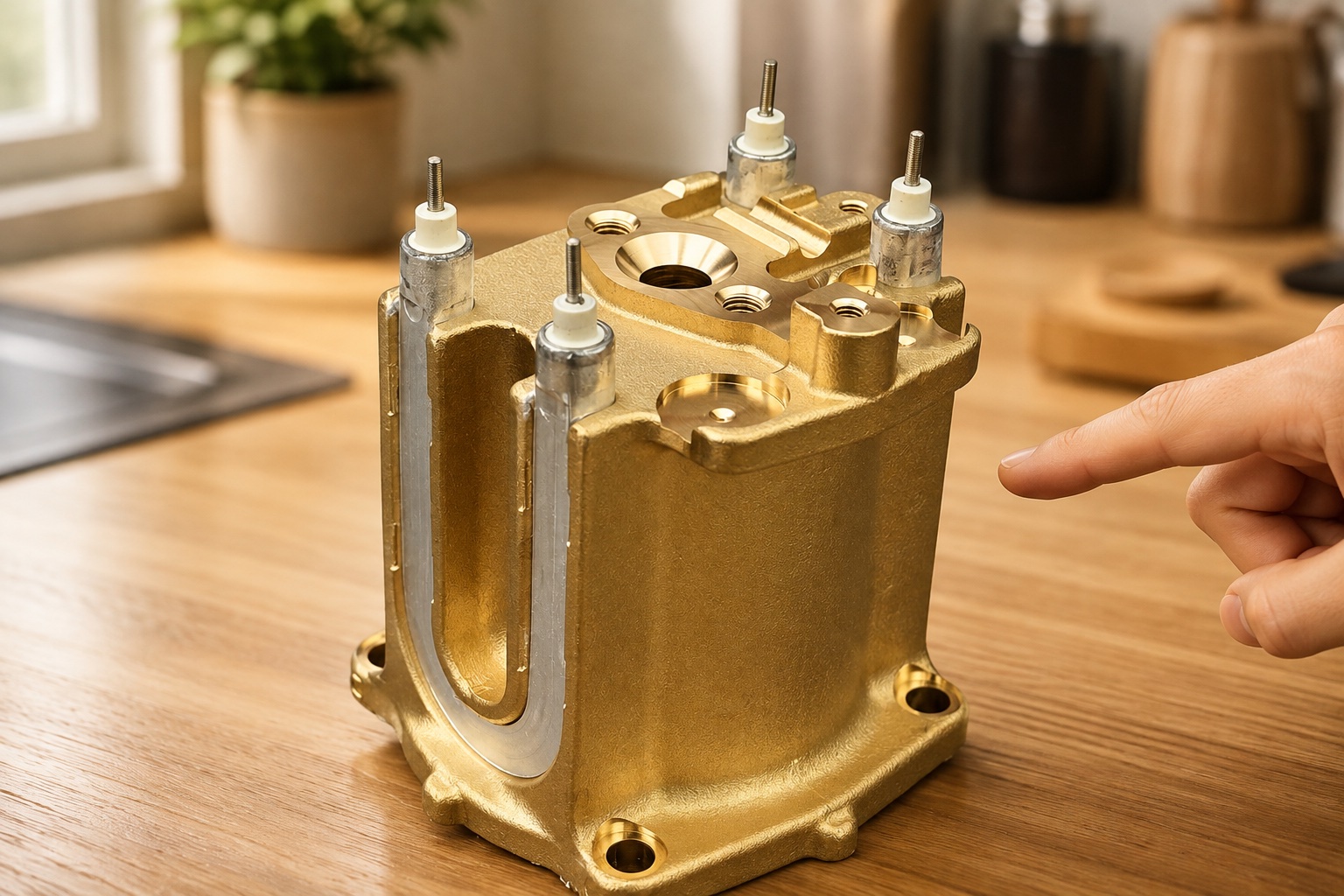
The boiler is the headline. Gaggia North America lists it as lead-free brass with a 3.5 oz capacity. Whole Latte Love, the primary North American distributor, puts the E24 boiler at 3.68 oz against 2.5 oz on the previous version, and the physical weight at 1,349.80 g against 506.81 g. Whichever figure you use, the mass roughly tripled, and mass is what buys thermal stability on a machine with no electronic temperature control.
4. Boilergate, and Why It Still Matters in 2026
The 2023 and 2024 Evo Pro used an aluminium boiler with an internal anti-scale coating, a food-safe compound called EXELIA 3010. On a run of machines the coating failed to polymerise properly during manufacture, and it began flaking off into the water, sending black specks out of the steam wand and into the cup. The affected units traced back to production weeks 19 through 44, and by January 2024 both Gaggia and Whole Latte Love were offering refunds and exchanges.
The fix that stuck was not a better coating. It was the E24’s brass boiler, which needs no anti-scale lining at all. The current machine solves the problem by deleting the part that caused it.
If you are buying new from an authorised seller in 2026, you are getting the brass boiler. If you are buying used, ask the seller whether it is an E24, and treat black specks in the drip tray as a deal breaker rather than a quirk.
5. In Use, Day to Day
There is no PID controller, which means the E24 uses a thermostat and you manage temperature yourself. The traditional technique is temperature surfing: running a short blank shot of water through the group to settle the boiler into the right part of its heating cycle before you brew. On the older Evo Pro this mattered a great deal. On the E24 it matters less.
Whole Latte Love’s published measurements put extraction temperature variance on the E24 at about 3°F, spanning 199.6°F to 202°F, against roughly 7°F on the aluminium-boiler Evo Pro. That is a meaningful narrowing for a machine with no electronics doing the work, and it is the practical benefit of all that brass mass.
The trade is warm-up time. The same measurements show the E24 reaching brew temperature in 90.5 seconds versus 71.3 seconds for the lighter boiler. Twenty seconds is not a reason to choose differently, but reaching brew temperature is not the same as being thermally settled, and the group and portafilter need to be warm too.
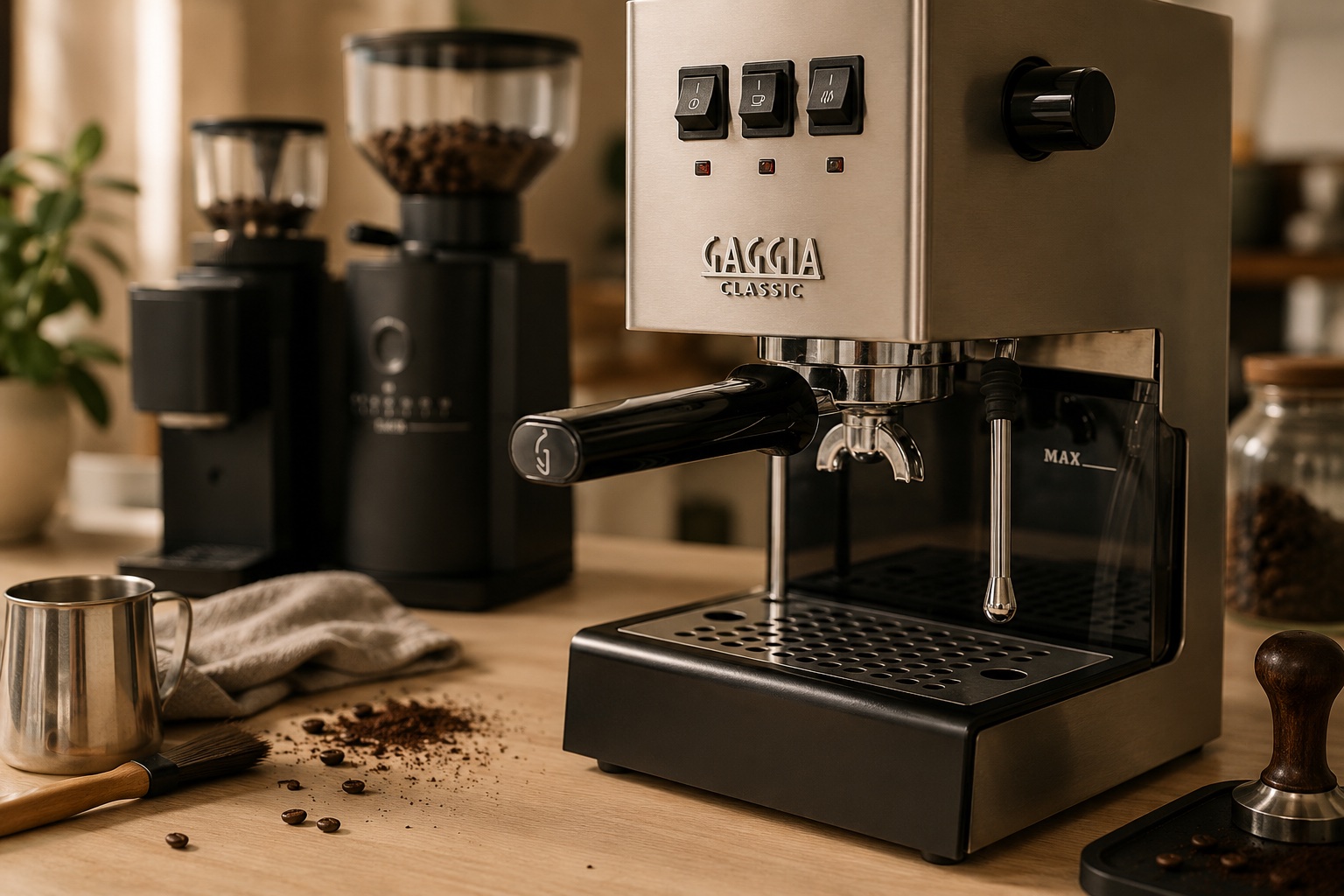
The three way solenoid does exactly what it should. Pressure above the puck is released the moment the shot stops, so the spent puck comes out as a dry disc you can knock into a bin instead of a wet slurry you have to rinse out. It is a small thing that changes how willing you are to make a second coffee.
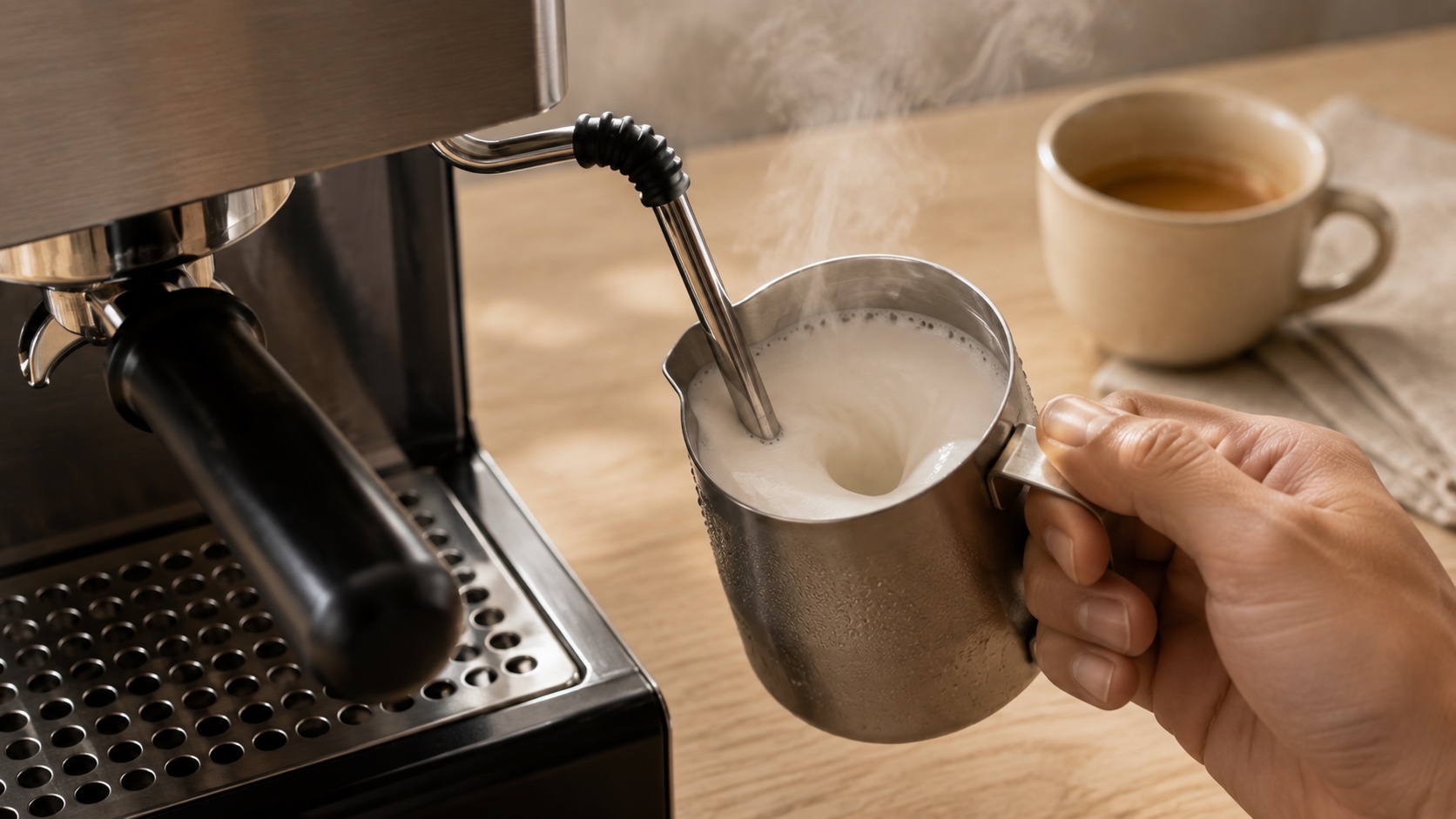
Steaming is manual and the wand is a real commercial-style two-hole design. It will make proper microfoam, and it will also make a hot bubbly mess for your first week. Because this is a single boiler, brewing and steaming use the same heating element at different temperatures, so you brew first, then wait for the machine to climb to steam temperature. That sequencing is the main ergonomic cost of a single boiler machine and it is not something the E24 changes.
6. Results in the Cup
Out of the box at 9 bar, the E24 produces espresso that tastes balanced rather than harsh. The older 15 bar-at-the-puck arrangement tended to over-extract the edges of the shot and push bitterness forward, and correcting it meant opening the machine up and adjusting the valve yourself. Having 9 bar set at the factory removes the most common first modification people used to make.
What you get in return for the manual approach is range. Because nothing is automated, a change you make is a change you can taste, and the machine is honest about your grind.
That honesty leads to the biggest budgeting mistake people make here: the grinder matters more than the machine does. Espresso needs a grinder that can adjust finely in the espresso range, and a machine like this will simply make bad coffee if fed inconsistent grounds. Our Breville Smart Grinder Pro review covers a common pairing at this level, and if the whole idea of dialling in is new, start with choosing the right grind size.
Beans matter too, though less dramatically. If you are deciding what to put through it, we have written about the best coffee beans for espresso and about single origin espresso versus blends.
7. Where It Falls Short
Every machine at this price is a set of compromises, and these are the E24’s real ones.
- The included accessories are poor. You get a plastic tamper and a coffee scoop from Gaggia, plus two single-walled baskets and one pressurised basket. The plastic tamper is genuinely unpleasant to use and should be replaced immediately with a 58mm metal tamper. Budget for that on day one.
- No PID and no temperature readout. The brass boiler narrows the swing but does not remove it, and there is no display telling you where you are in the cycle.
- Single boiler sequencing. Brew, then wait, then steam. If you are making four milk drinks for guests, you will feel it.
- The warranty is one year through Gaggia North America, which is short for a machine sold on the promise of lasting a decade. Some authorised retailers extend it, so check before you buy.
- The real cost is not $549. Add a competent espresso grinder and a decent tamper and the honest entry price is considerably higher.
Buy it if
- You want a 58mm commercial platform you can repair and modify for years
- You are buying new, or can confirm the unit is an E24 with the brass boiler
- You already own, or are budgeting for, a grinder that handles espresso
- You want to learn espresso as a skill, not skip it
- You make a small number of drinks per session
Skip it if
- You want a button-press espresso with automatic milk
- You are shopping used and cannot confirm the revision
- Your budget is $549 total, including the grinder
- You regularly make several milk drinks back to back
- You have no patience for a warm-up period before the first coffee
8. Alternatives Worth Considering
Breville Bambino Plus, $499.95. The opposite philosophy. Its ThermoJet heating system reaches extraction temperature in about 3 seconds, and it will texture milk automatically. The compromises are a 54mm portafilter rather than the 58mm commercial standard, and a much smaller upgrade and repair ecosystem. If your priority is a good flat white on a weekday morning with minimum fuss, this is the better buy, and it costs less.
Rancilio Silvia M, around $995. The same single-boiler, no-PID philosophy as the Gaggia, built heavier and with a larger brass boiler. It is the natural step up if you know you want this style of machine and can spend nearly double. It does not solve the sequencing or the warm-up wait, because it is not trying to.
Rancilio Silvia Pro X, $2,195 MSRP. A dual boiler with PID, listed only to mark where the compromises actually disappear. Brew and steam at once, hold a set temperature, stop thinking about it. No amount of modification to a Classic will get you there.
For a very different design brief, our SMEG ECF03 review covers a machine chosen as much for how it looks on a counter.
9. Verdict
Buy the Gaggia Classic Pro E24 at $549 if you want to learn espresso on a 58mm commercial platform and keep the machine for a decade. The brass boiler resolved the one serious defect in this line, thermal behaviour is now respectable for a machine with no electronics, and the parts and community around it are unmatched at the price.
Replace the plastic tamper immediately, and spend at least as much on the grinder as you did on the machine. If you would rather not do any of that, buy the Breville Bambino Plus at $499.95 and enjoy your mornings.
If you are buying used, the only question that matters is whether it is the E24.
FAQ
Is the Gaggia Classic Evo Pro good for beginners?
Yes, if the beginner wants to learn. It is a genuinely forgiving machine to own because parts and guidance are everywhere, but it is not forgiving of bad grinding or a rushed workflow. Someone who wants coffee without technique will be happier with an automatic machine.
What is boilergate on the Gaggia Classic?
Boilergate refers to an internal anti-scale coating on 2023 and 2024 Evo Pro aluminium boilers that failed to cure properly and flaked into the water, producing black specks in the coffee and steam. The affected machines came from production weeks 19 to 44, and Gaggia and its US distributor offered exchanges and refunds from January 2024. The current E24 uses a solid brass boiler with no coating.
Does the Gaggia Classic Pro E24 have a PID?
No. It uses a thermostat, not a PID controller, so there is no set-and-hold temperature or digital readout. The larger brass boiler narrows the swing to roughly 3°F during extraction according to distributor measurements, which is why temperature surfing matters less than it did on the older model.
Is the Gaggia Classic Evo Pro 9 bar out of the box?
Yes on current North American models, where the over pressure valve is calibrated to 9 bar at the factory. The 15 bar figure in the specifications refers to the Ulka pump’s capability, not the pressure reaching the coffee. Older Classic machines needed this adjustment done by hand.
What size portafilter does the Gaggia Classic Evo Pro use?
58mm, in stainless steel. That is the commercial standard, which means baskets, tampers, distribution tools and bottomless portafilters from almost any brand will fit.
Do I need to upgrade the tamper and baskets?
The tamper, yes. The plastic tamper included is not usable long term and a 58mm metal tamper is an inexpensive first purchase. The single-walled baskets supplied are workable; precision baskets from brands like IMS or VST are a refinement to consider later, not a requirement.
How long does the Gaggia Classic Pro E24 take to warm up?
Distributor testing put it at 90.5 seconds to reach brew temperature, against 71.3 seconds for the previous lighter boiler. In practice, allow longer before pulling a shot you care about, so the group head and portafilter come up to temperature as well.
Note: Some links on La Milan Cafe may earn us a commission at no extra cost to you, which helps support the work. Brewing involves hot water and, for some methods, pressure or electrical appliances — always follow the manufacturer’s instructions.
No Comments