

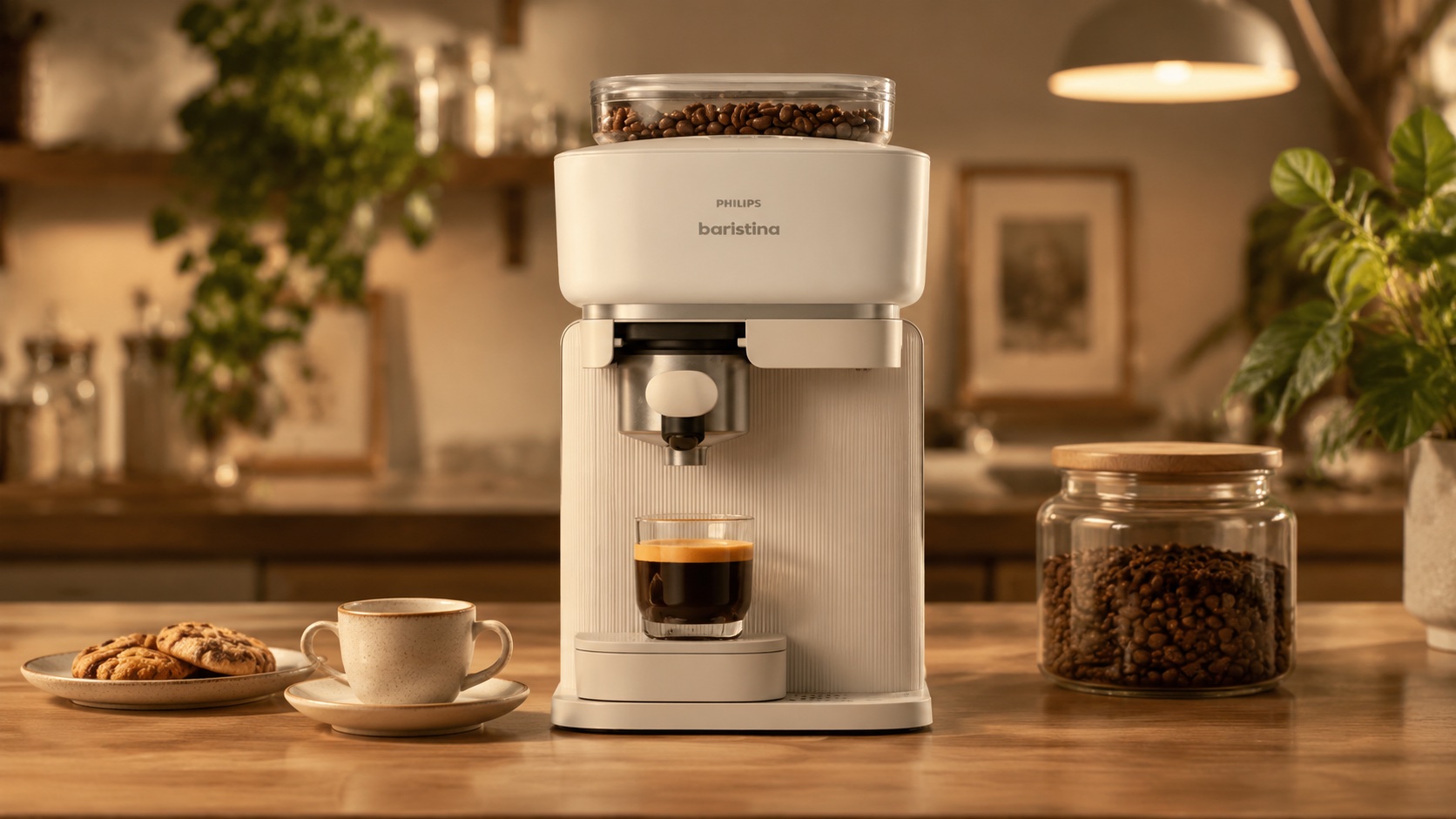
Philips Baristina Review: Fresh Beans, No Grind Control
1. The Verdict, in Two Sentences
The Philips Baristina does one thing extremely well: it turns whole beans into a drinkable espresso in a single movement, with no scale, no tamper and no technique to learn. What you give up for that is the grinder, which is fixed at the factory and cannot be adjusted, so the one lever that actually corrects a bad shot is not available to you.
That trade is either the entire point or a dealbreaker, and which one depends less on your budget than on whether you want to be involved in the coffee.
2. Philips Baristina Specifications at a Glance
Specs and prices checked August 2026. Models and pricing change without notice.
| Specification | Philips Baristina |
|---|---|
| Type | Compact automatic espresso machine, whole bean |
| Pump pressure | 16 bar |
| Grinder | Ceramic burrs, fixed grind setting, not adjustable |
| Bean container | 170 g |
| Water tank | 1.2 liters, removable, BPA free |
| Standard drinks | Espresso 40 ml, Lungo 110 ml |
| Strength control | Intensity boost, grinds a larger dose |
| Pre-ground option | Yes, a decaf bypass, 10 g maximum |
| Portafilter | 51 mm, pressurized basket, automatic dosing and tamping |
| Cup clearance | 95 mm with the drip tray, 135 mm without it |
| Dimensions | 180 mm wide, 345 mm high, 380 mm deep |
| Weight | About 4.8 kg |
| Milk system | None on the base machine, a separate frother ships with BAR303 and BAR311 |
| Warranty | 2 years |
| Price | About $350 to $370 street in the US against a $449.99 list, £299.99 RRP in the UK |
Two words in that table do the heavy lifting. Portafilter is the handled basket you lock into an espresso machine, the part that makes this look like a cafe machine rather than a pod machine. Pressurized basket means the basket has a restricting valve behind it that builds back pressure artificially, so it produces crema from almost any grind. That is what makes a fixed grinder workable at all, and it is also why the ceiling here is lower than the 16 bar figure suggests.
3. Who It Is For
Be honest with yourself about which of these you are, because the machine is unusually clear about its audience.
- You are coming off capsules and want fresher coffee without a new hobby. This is the strongest case for the Baristina by some distance.
- You have very little counter space. At 180 mm wide it is narrower than most bean to cup machines, which is a real constraint solved rather than a marketing line.
- You drink one or two coffees a day, black or with milk you heat separately.
- You want the same cup every morning, not a different one depending on how you dosed.
If you are moving up from a pod system, the economics also change in your favor: you buy whole beans from any roaster you like instead of whatever your machine’s format allows. Our guide to choosing beans for espresso matters more here than on most machines, for a reason covered in section 6.
4. Build and Design
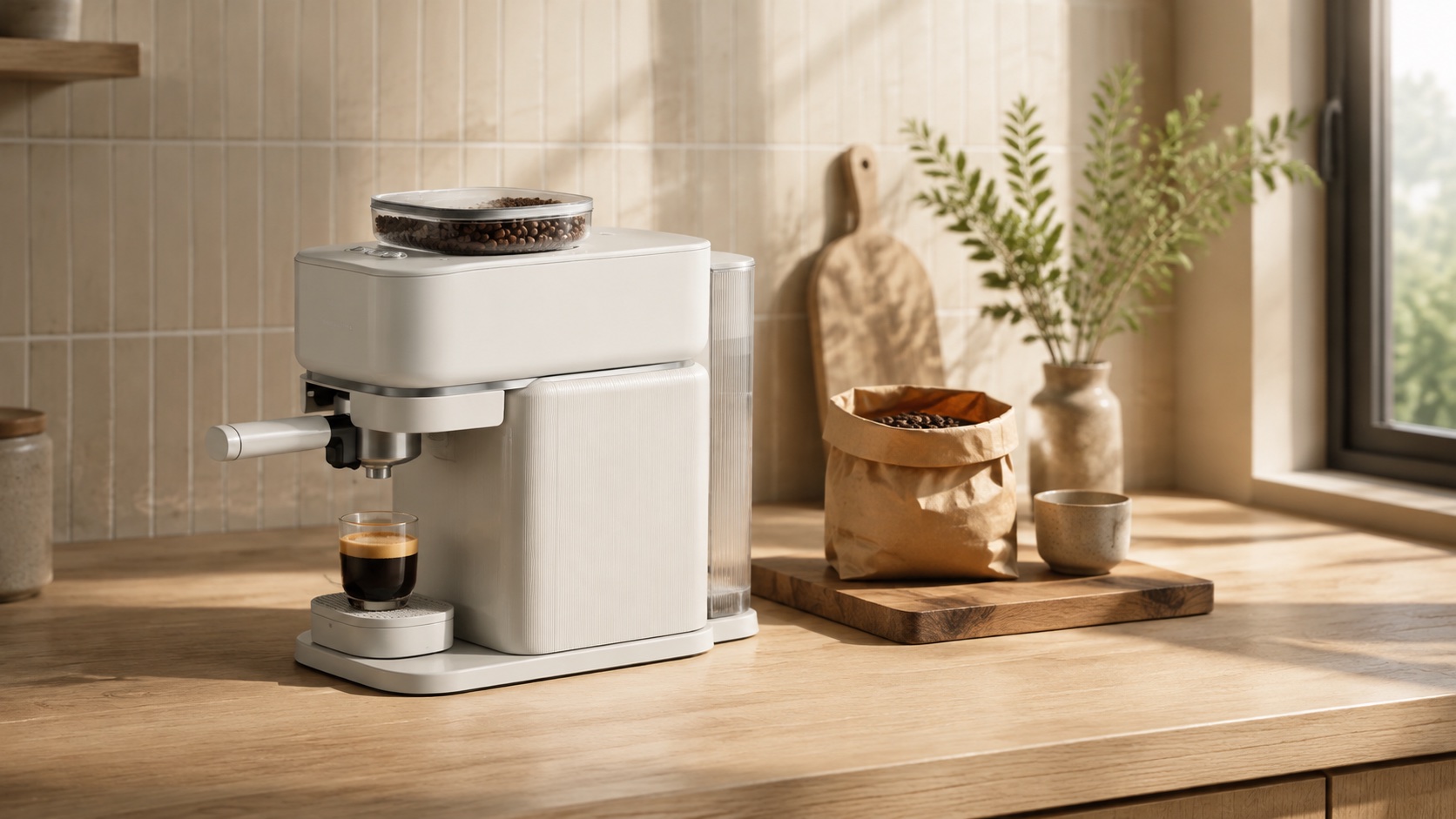
The Baristina is small and light, about 4.8 kg, and the housing is largely plastic. Philips says the casing uses over 50% recycled plastic, which is good for the landfill and neutral for the hand: it does not feel like a metal machine, because it is not one. At this price that is a fair result rather than a disappointment, though anyone cross-shopping a Gaggia will notice the difference immediately.
The portafilter is the piece that carries the design. It is a genuine 51 mm handled unit that you insert, and depending on the model it comes with a plastic, painted or ash wood handle. It also has a puck release button, so you invert it over a bin, press, and the spent coffee drops out without a knock box or a bang on the counter.
Controls are three buttons on the top panel: Espresso, Lungo and Intensity boost. There is no screen, no app and no menu tree. Everything is a light that blinks slowly, blinks fast, or stays on, and the manual has a full page decoding what each pattern means. It is legible once you learn it, and slightly opaque before then.
5. In Use, Day to Day
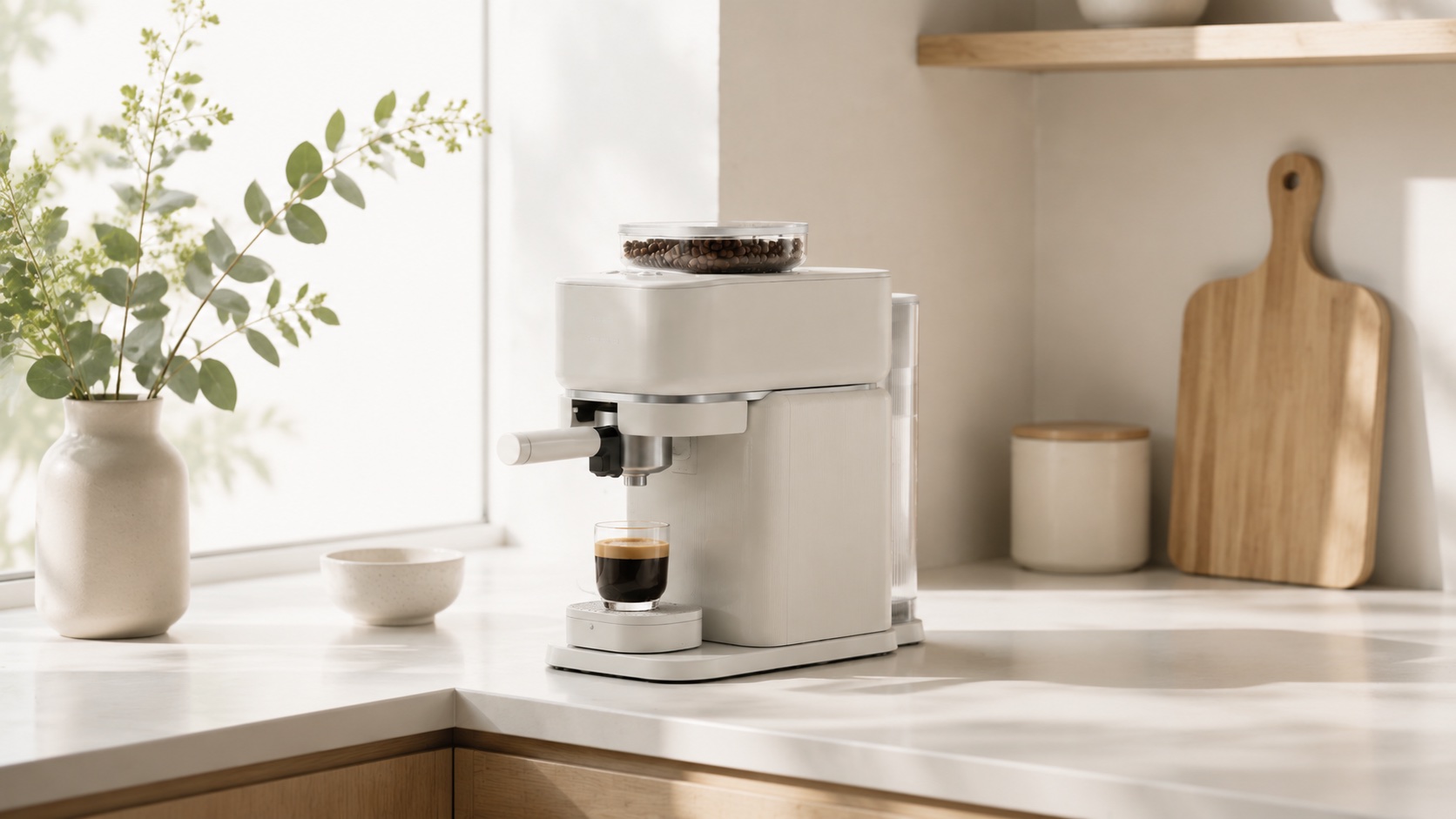
The sequence is genuinely as simple as advertised. Fill the hopper, fill the tank, insert the empty portafilter, press Espresso or Lungo, then slide the handle to the right until it clicks. The machine grinds directly into the basket, doses, tamps, returns the portafilter to the brewing position on its own and pulls the shot.
The detail that makes this fast in practice is that you do not wait for warm up. Philips calls it direct start: select a drink and the machine heats while you are already swiping, so the heat up overlaps the grind rather than preceding it. A thermoblock, meaning a small inline heater rather than a stored tank of hot water, is what allows that.
A few behaviors are worth knowing before you own one, and they are the sort of thing a spec sheet will not tell you:
- Empty the portafilter after every single brew. Philips lists starting a new shot on top of an old puck as a direct cause of the machine leaking around the portafilter. This is a habit, not a fault, but it is not optional.
- After you change beans, the first cup or two will be off. Philips’ own troubleshooting says the dosing system needs to adjust and tells you to brew one or two more cups to settle it. Budget for that whenever you open a new bag of a different roast.
- The portafilter is not dishwasher safe. Philips is explicit that washing it will discolor and damage it. It rinses under the tap in seconds, and soaks in warm soapy water for about ten minutes when it needs more, but a wooden handle must stay dry.
- Only the plastic drip tray lid is dishwasher safe. The metal drip tray lid is not, which is a distinction worth reading twice if you bought a model with the metal one.
- Cup height is 95 mm with the drip tray in place. Pull the tray out and you get 135 mm, which covers most travel mugs.
Maintenance is otherwise light, and this is where the Baristina genuinely beats a conventional bean to cup machine. There is no enclosed brew group hiding wet grounds where you cannot see them. Descaling is prompted for you: when the Espresso and Lungo lights blink together after a brew, it is asking. Philips specifies its CA6700 descaler, warns against vinegar and other acids in the strongest terms, and notes that skipping descaling voids the warranty. The cycle takes up to about 30 minutes. There is no water filter offered for this machine, so descaling on schedule is your only defense against hard water.
6. Results in the Cup
Within its range the Baristina is consistent, which is the whole promise and it delivers on it. Because the dose, the tamp and the grind are all removed from your hands, the shot you get on a Tuesday is the shot you get on a Saturday. Reviewers who have spent time with it are consistently positive about the espresso for the money, and TechRadar rated it the best budget bean to cup machine it had tested, with the fixed grind noted as the one real limitation.
The lungo is the weaker of the two. Coffeeness found it thin and smoky, with less body and little acidity, which is what usually happens when you push more water through a dose sized for a shorter drink.
Here is the part that changes how you shop. On a normal espresso machine, a sour, fast shot is fixed by grinding finer, and a bitter, slow one by grinding coarser. That is what grind size does, and on the Baristina you do not have it. Your only remaining variables are the bean itself and the Intensity boost button, which does not change extraction technique at all, it simply grinds a larger dose.
So bean selection stops being a preference and becomes the adjustment. A medium to medium dark roast, reasonably fresh but not three days off the roaster, will suit the factory grind. A dense, very light single origin is the thing most likely to disappoint you, because the classic fix for it is unavailable.
7. Where It Falls Short
✅ Buy it if
- You are replacing a capsule machine and want fresh beans without learning espresso
- Your counter is narrow and a normal bean to cup machine will not fit
- You value the same result every morning over the best possible result
- You want a machine you can actually see into and clean in under a minute
- You drink espresso or lungo black, or heat your milk separately anyway
⛔ Skip it if
- You want to dial in a shot. The grinder is fixed, and no amount of button pressing substitutes for it.
- You buy light roast single origins. The one tool that makes them work is missing.
- You want latte art. There is no steam wand at all, and the accessory frother is an automatic whisk, which is a different thing from steamed microfoam. It is a separate purchase at $99.99 unless you buy the BAR303 or BAR311 bundle.
- You want to learn espresso. Nothing here transfers to another machine, because you never touch the variables.
- You care about the pressurized basket. It guarantees crema, but it caps how good the coffee can get, and you cannot swap it for a standard basket.
- You want a metal machine. Most of this one is plastic.
If two or more of those apply, buy something else. The next section says what.
8. Alternatives Worth Considering
Breville Bambino, $299.95. A proper semi automatic with a real steam wand, cheaper than the Baristina. The catch is honest and significant: it has no grinder, so you must add one, and a grinder good enough for espresso starts around $200. Total cost lands well above the Baristina, and you will have to learn to use it. In exchange, everything is adjustable and it will still be a good machine in five years.
Gaggia Classic Evo Pro, from $499 in stainless and up to $549 in the colors. The traditional answer, a metal machine with a commercial style group head that people modify and keep for a decade. Also grinderless, also a learning curve. Our Gaggia Classic Evo Pro review covers which revision to buy, because it matters.
Stay on capsules. If reading section 7 made you tired, that is useful information. A good capsule machine is cheaper up front and the Baristina’s advantage over it is mostly bean freedom and running cost, not a transformed cup.
A full bean to cup machine, if milk drinks are the actual goal. Machines with integrated milk systems handle cappuccinos in one press, and our De’Longhi Maestosa review shows what that looks like at the top of the market. Expect a much larger footprint and an enclosed brew group to clean.
9. Verdict
Buy the Philips Baristina if you are leaving capsules behind and want fresh ground espresso with no ceremony, in a kitchen with no room to spare. At roughly $350 to $370 it does something no other machine at that price does, which is grind, dose, tamp and brew in one motion and stay easy to clean afterwards. For that buyer it is a genuinely good purchase and the simplest fresh bean espresso available.
Do not buy it if you suspect you will want more later. The fixed grinder is not a feature you grow into, it is a ceiling, and the Baristina has no upgrade path past it. If that describes you, spend $299.95 on a Breville Bambino, add a grinder when you can afford one, and accept the longer road.
Pair it with a medium roast you like and buy it in small bags. On this machine the beans are the only adjustment you have, so make them count.
FAQ
Can you adjust the grind size on the Philips Baristina?
No. The ceramic grinder is set at the factory and Philips provides no adjustment dial. This is the machine’s single biggest limitation, and it means the usual fix for a sour or bitter shot is not available to you. Your practical alternatives are changing beans or using the Intensity boost button, which grinds a larger dose rather than a different grind size.
Does the Philips Baristina make cappuccinos and lattes?
Not on its own. The base machine has no steam wand. Philips sells a separate Baristina milk frother for $99.99, and it is included in the BAR303 and BAR311 bundles. That frother makes hot or cold foam automatically, but it is not a substitute for steaming milk by hand if latte art is what you are after.
Is the Philips Baristina better than a capsule machine?
For freshness and choice, yes. You grind whole beans immediately before extraction instead of using coffee that was ground and sealed months ago, and you can buy from any roaster rather than one capsule format. The workflow is barely more work: insert the portafilter, swipe, and empty it afterwards.
Can you use pre-ground coffee in the Baristina?
Yes, through the decaf bypass. Add up to 10 g, or one level tablespoon, of ground coffee to the portafilter, insert it, then press and hold the Intensity boost button for five seconds. You stop the shot yourself by pressing the button again, so the volume is manual on this route.
Is the Baristina portafilter dishwasher safe?
No. Philips states that dishwashing the portafilter will discolor it and damage the materials. Rinse it under the tap instead, pressing the ejection button as you go, and soak the head in warm soapy water for about ten minutes when it needs a deeper clean. If yours has a wooden handle, keep the handle out of the water.
How often does the Philips Baristina need descaling?
The machine tells you. When the Espresso and Lungo buttons blink together after you brew, it is due. Philips specifies its CA6700 descaling solution, 125 ml per cycle, and the process takes up to about 30 minutes including the flush. Never use vinegar or other household acids, and do not skip it, because Philips voids the warranty for descaling failures.
Disclosure
Note: Some links on La Milan Cafe may earn us a commission at no extra cost to you, which helps support the work. Brewing involves hot water and, for some methods, pressure or electrical appliances — always follow the manufacturer’s instructions.
No Comments