

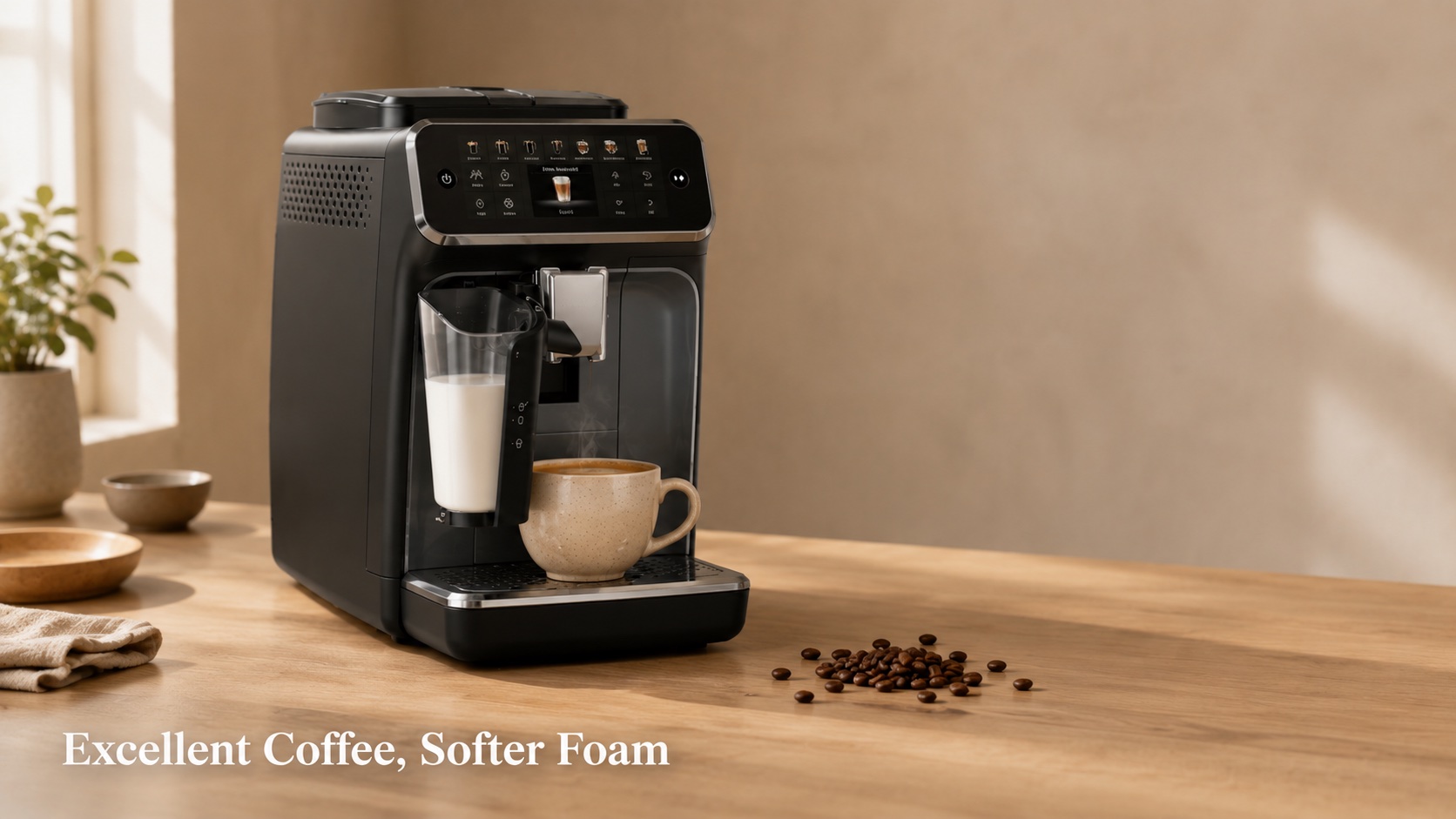
Philips LatteGo 4400 Review: Excellent Coffee, Softer Foam
Philips LatteGo 4400 Review: Excellent Coffee, Softer Foam
The Philips Series 4400 is the machine you buy when you want fresh ground coffee every morning and you do not want a hobby. Beans in the top, milk in the jug, one button, done. It grinds, doses, tamps, extracts and froths without asking you to learn anything, and for a lot of Australian households that is exactly the right trade.
There is one compromise, and it is worth knowing before you spend the money. The LatteGo milk system is genuinely brilliant to clean, but the foam it makes is soft and loose rather than dense. If you drink flat whites and lattes you will be happy. If you want a proper stiff cappuccino cap, this is not the machine, or at least not without a separate frother.
Price is the other thing to be clear about. This machine swings from a AU$1,199 recommended retail price down to deals under AU$600, and whether it is worth buying depends almost entirely on which of those numbers you are looking at today.
| Specification | Philips Series 4400, EP4441/20 |
|---|---|
| Type | Fully automatic bean to cup |
| Drinks | 12 hot and iced recipes |
| Grinder | 100% ceramic, 12 settings, dial inside the hopper |
| Bean hopper | 275g |
| Water tank | 1.8L |
| Pump pressure | 15 bar |
| Milk system | LatteGo, two part, tube free, dishwasher safe |
| User profiles | 2 profiles plus a guest mode |
| Power | 1500W |
| Dimensions (H x W x D) | 371 x 433 x 246mm |
| Weight | 8kg |
| Warranty | 2 years |
| Retail price (AU) | AU$1,199 RRP, widely discounted |
Specifications and prices checked 27 August 2026. Models and pricing change without notice.
1. What Is the Philips LatteGo 4400?
The 4400 is a fully automatic espresso machine, often called bean to cup. That means the grinder, the brew unit and the milk system all live inside one box, and a single button press takes whole beans through to a finished drink in the cup. You never touch a portafilter, and there is no tamping, no dosing and no purge routine.
The Australian model is the EP4441/20 in glossy black. It sits between the cheaper 3300 and 4300 machines and the 20 drink, four profile Series 5500 above it, offering enough recipes and customisation for a real household without flagship pricing.
- Best suited to: beginners, couples and small households who want fresh bean coffee daily
- Not suited to: anyone who wants to learn espresso as a craft, or who prizes dense milk foam
- Footprint: 433mm wide and 246mm deep, so it fits under most overhead cabinets
2. Why the 4400 Is Easy to Live With
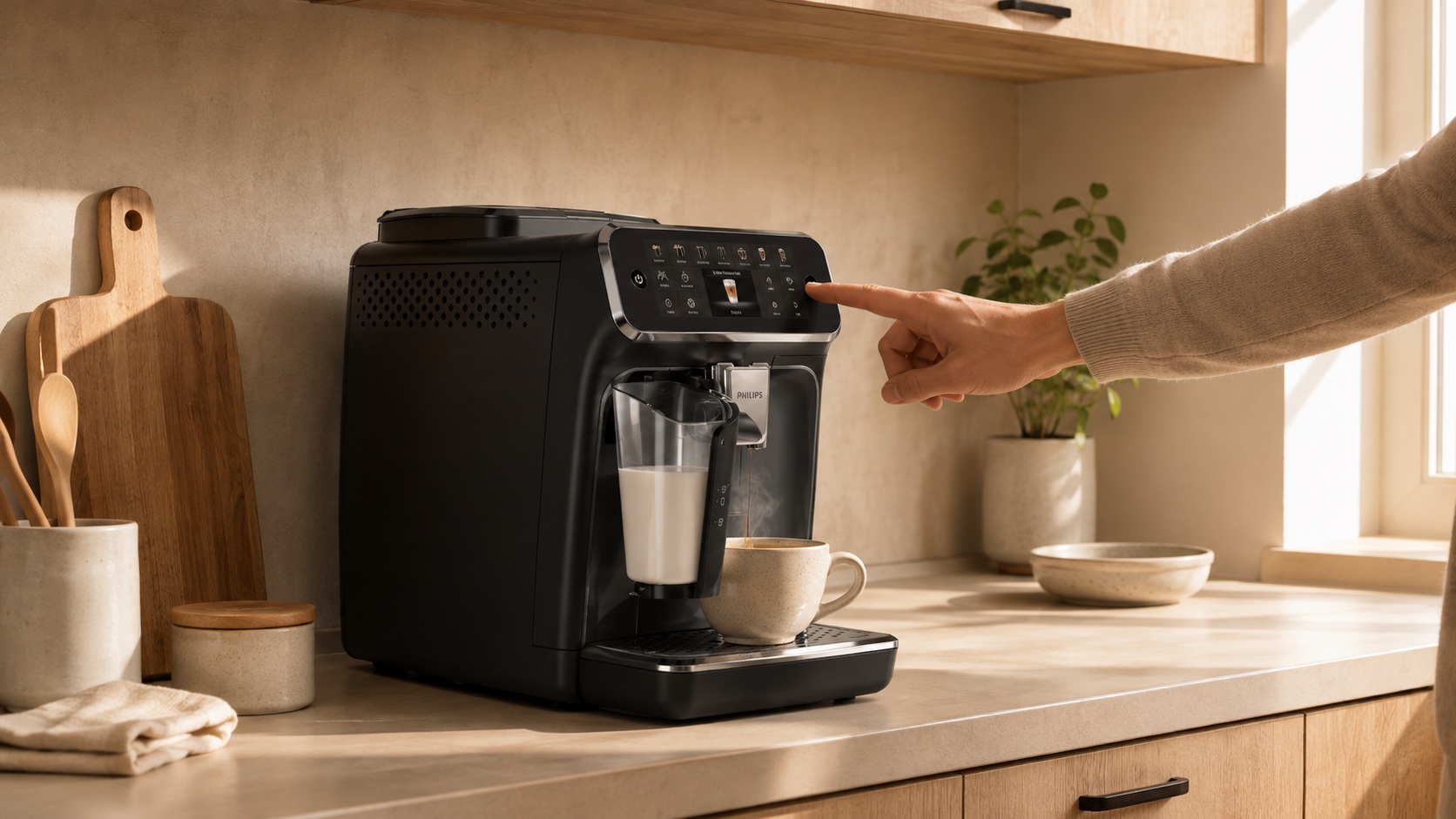
The interface is the quiet win. Twelve recipes sit on the panel, including flat white, latte, iced latte and long black, and each is a single press. You can adjust strength and volume per drink, then save the result to one of two user profiles, with a guest mode on top so a visitor cannot overwrite what you have dialled in. QuickStart has it ready to brew almost immediately after switch on, and the water tank and drip tray are reached from the front.
The grinder is 100% ceramic with 12 settings, adjusted by a dial inside the bean hopper. Ceramic burrs stay sharp longer than steel in this class and transfer less heat to the beans. One practical note: only turn that dial while the grinder is running, or you risk jamming the burrs against a bed of stationary beans.
3. How Good Is the Coffee?
Good, and better than the price suggests when the grind is right. TechRadar lived with the 4400 for two weeks and reported excellent coffee overall, calling it a near perfect option for newcomers and smaller households, with a genuinely good espresso shot and a recipe range that suits most drinkers.
The qualifier in every credible review is grind adjustment. Out of the box the machine is set conservatively, and the single biggest improvement most owners make is going finer, one step at a time, over several drinks. Bean to cup machines dose automatically, so grind size is the main lever you have left over strength and body.
- Espresso: genuinely good, with real crema, once the grind is dialled in
- Long black: the recipe most Australians will use daily, and it holds up well
- Milk drinks: the coffee underneath is fine, the foam on top is the issue, see below
- Beans: stick to medium roast to start, since very dark oily beans clog automatic grinders
4. The LatteGo Milk System Is the Weak Point
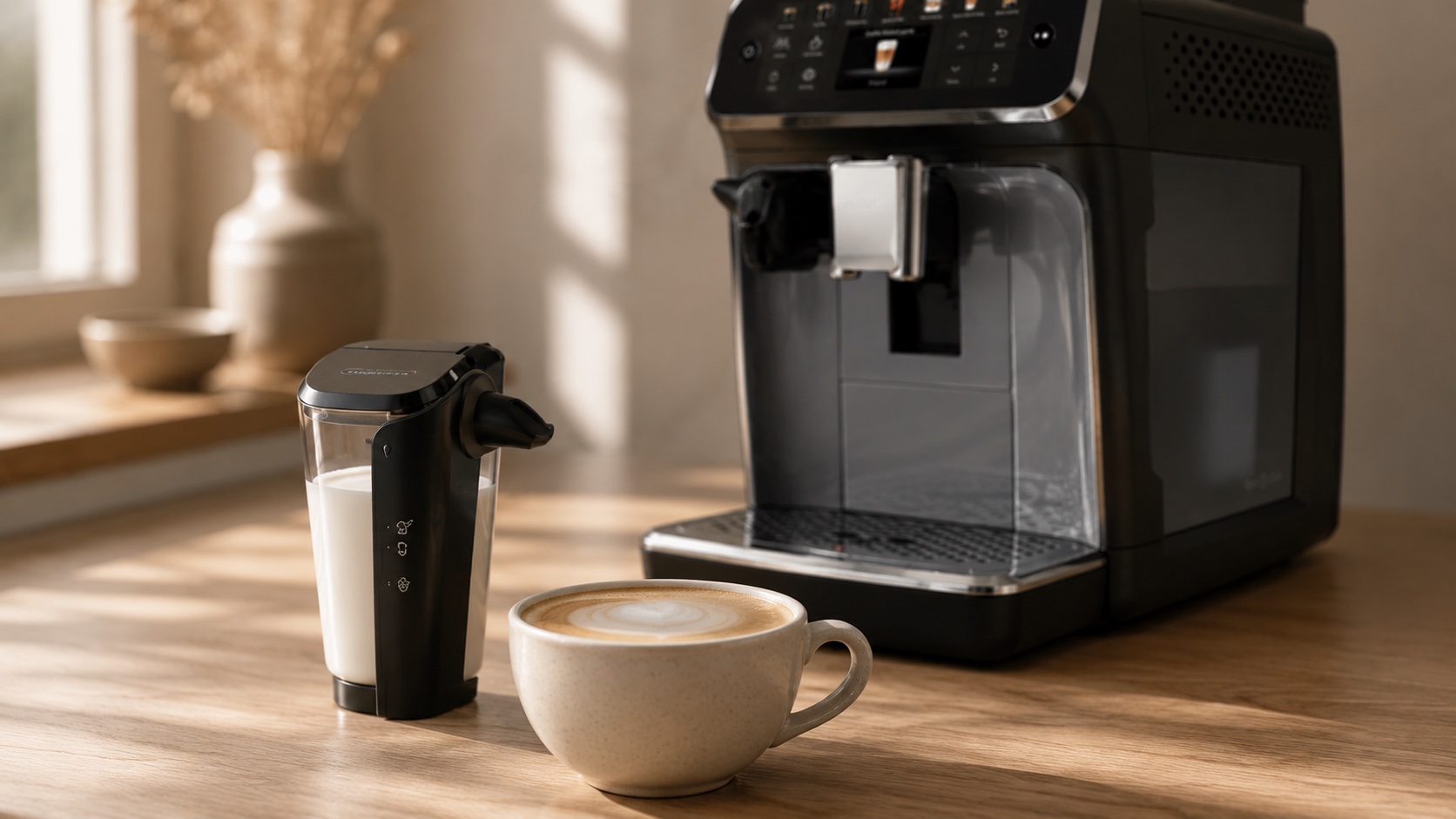
This is the honest negative, and it is the one thing that should decide the purchase for some readers. LatteGo is a two part, tube free container that clips onto the front of the machine, and it froths by drawing milk through a channel rather than pushing steam through a wand. The design is superb for cleaning. It is less good at building structure in the milk.
Independent testing lands in the same place from two directions. TechRadar’s two week test found the milk foaming was the weakest part of an otherwise excellent machine. Coffeeness, testing the same series, described the result as acceptable foam that will not blow your mind, and noted that LatteGo has never produced genuinely luxurious foam.
What that means in the cup: the foam is soft, wet and pourable. For a flat white or a latte, where you want thin microfoam integrated into the coffee, that is close to what you actually want. For a cappuccino, where the point is a thick insulating cap, it falls short. Plant milks make it harder again, since oat and almond froth differently to dairy and the machine gives you no control to compensate.
If cappuccino foam is the reason you are buying a coffee machine, budget for a separate frother. The Philips Baristina Milk Frother sits around AU$149 in Australia and handles hot, cold, dairy and non dairy milk with far more structure than any automatic milk system in this price band. That is a real cost to add on, and you should add it to the sticker price before you compare machines.
5. What About Iced Coffee?
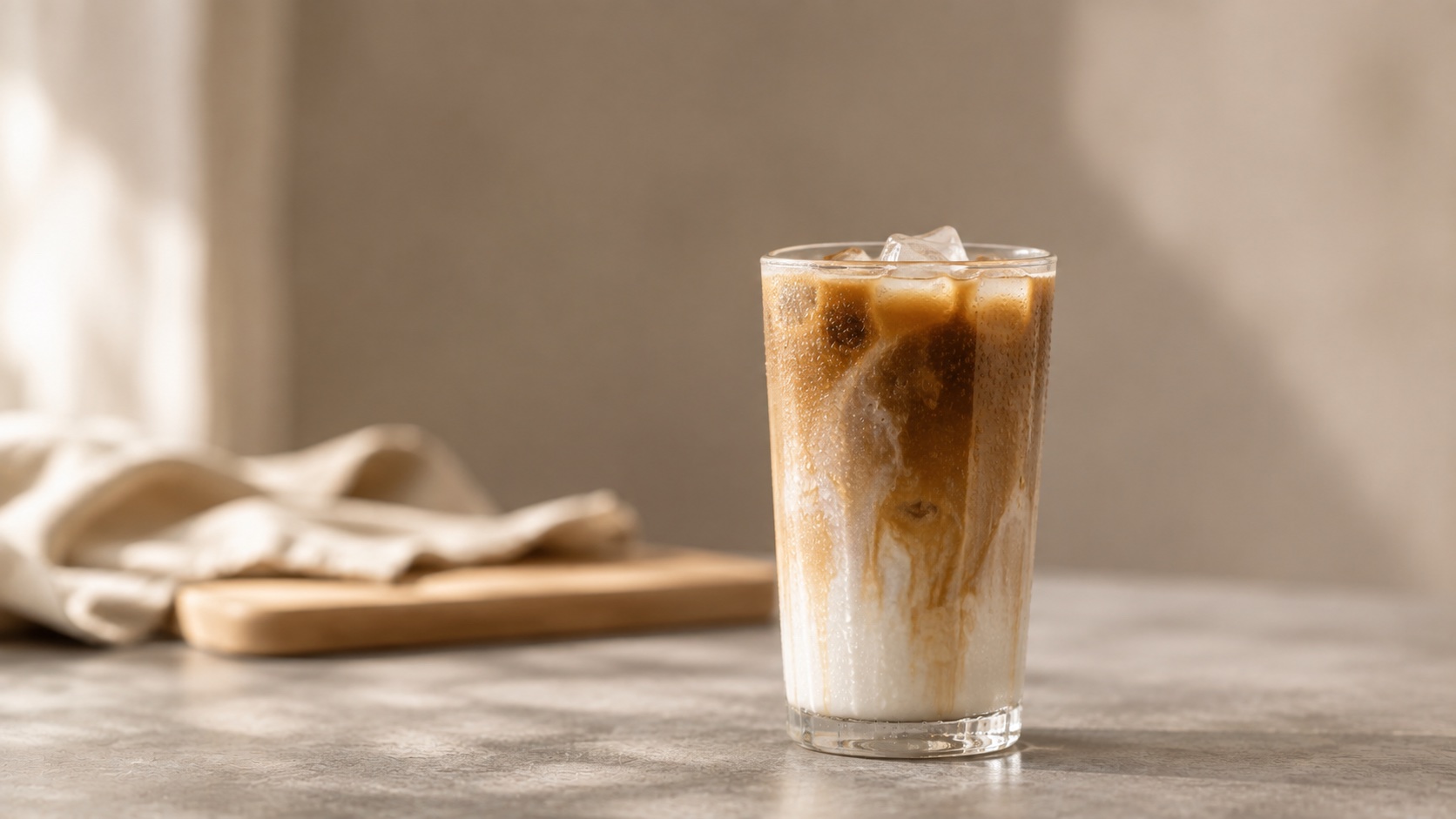
The 4400 makes iced drinks, and it does not make cold brew. Those are two different things and the distinction matters.
Philips calibrates the machine to extract at lower temperature and lower pressure for its iced recipes, so the coffee arrives cooler and does not shock the ice into instant dilution. That is a sensible bit of engineering and it produces a decent iced latte. It is still a hot extraction, just a gentler one.
Cold brew is a different process: coarse grounds steeped in cold water for twelve to twenty four hours, producing a lower acidity, sweeter concentrate. No automatic espresso machine at this price does that. If real cold brew is what you are after, look at a machine built for it such as the SMEG ECF03, or steep it yourself in a jug overnight for nothing.
6. Cleaning and Maintenance
This is where the 4400 earns back what it gives up on foam. LatteGo comes apart into two pieces with no tubes, no valves and no narrow passages, and Philips says it rinses in about ten seconds. Both parts are dishwasher safe. Anyone who has scrubbed sour milk out of a frothing tube will understand why that matters.
Philips also supports its AquaClean water filter and claims up to 5,000 cups before descaling is required, provided the filter is replaced as directed. Treat that as a manufacturer claim tied to correct filter use, not a guarantee: it depends on your water hardness and on you swapping filters on schedule, and Australian water varies enormously between cities.
- Daily: rinse the LatteGo parts, empty the drip tray
- Weekly: remove and rinse the brew group under the tap
- Ongoing: replace the AquaClean filter when the machine asks, or expect to descale sooner
- Watch for: the AquaClean filters themselves are a recurring cost, so factor them in
On noise, Philips claims SilentBrew reduces operating noise by up to 40% and the machine carries Quiet Mark certification. That is a real certification, but quieter is not quiet. Owner reports include people who found it loud despite the marketing, and reviewers have been careful to note the claim is Philips’ own rather than an independently measured result. Expect a noticeably quieter grind than an older machine, not a silent one.
7. How the Philips LatteGo 4400 Compares
| Machine | Price checked 27 Aug 2026 | Why you would pick it |
|---|---|---|
| Philips Series 4400 EP4441/20 | AU$1,199 RRP, often under AU$700 | Best value one touch machine when discounted |
| Philips Series 5500 EP5541/20 | AU$999 at JB Hi-Fi | 20 drinks, 4 profiles, same LatteGo foam limitation |
| De’Longhi Magnifica Evo ECAM290.31.SB | AU$999 direct, seen at AU$664 | Manual milk wand, so you control the foam |
| Ninja Luxe Cafe Premier ES601 | AU$1,049.99 RRP, AU$849.99 on sale | 3 in 1 with real cold brew, far more hands on |
The Philips 5500 is the obvious upgrade, but read what you are buying. It adds 20 drinks instead of 12 and four profiles instead of two, and it uses the same LatteGo system, so it does not fix the foam. Pay for it if you want more recipes, not better cappuccinos.
The De’Longhi Magnifica Evo is the more interesting comparison, because it takes the opposite approach to milk. You get a manual steam wand, which means learning to steam and deciding for yourself how dense the foam is. More work every morning, a much higher ceiling.
The Ninja Luxe Cafe Premier is the outlier: espresso, drip coffee and genuine rapid cold brew in one unit, with far more involvement required. It is the answer if the cold brew gap above is what bothers you.
If you would rather learn espresso than automate it away, a traditional machine such as the Gaggia Classic Evo Pro is a different proposition at a similar price. At the other end, the De’Longhi Maestosa and the Casarte Gold Cup Pro show where full automation goes without a budget limit.
8. What the AU$613 Deal Actually Means
On 20 August 2026, TechRadar reported the 4400 heavily discounted at Amazon Australia, and on 22 August a AU$613 delivered price was posted publicly: a AU$763 listing with a further AU$150 coupon applied at checkout. That is a strong price for this machine.
It is not the lowest it has ever been. The same model has been sold at AU$599 delivered, at AU$594 during a Prime event, and as low as AU$549 when a AU$150 coupon stacked on a AU$699 listing. Anyone telling you AU$613 is an all time low is wrong.
More importantly, coupon deals expire quietly. Checked on 27 August 2026, the machine was listed at AU$1,299 at Myer, AU$1,199 at The Good Guys and AU$964 at Appliances Online. Verify the live price and whether the coupon is still attached before you buy, because the number in the cart is the only one that counts.
Where that leaves the decision:
- Under AU$650: clearly good value, buy it
- AU$650 to AU$800: still reasonable, but compare the 5500 at AU$999 and the Magnifica Evo
- Above AU$900: wait. This machine goes on sale often, and paying near RRP for it does not make sense
9. Buy It or Skip It
Buy it if
- You want fresh ground coffee daily with no technique to learn
- You mainly drink flat whites, lattes, long blacks and iced coffee
- You are buying at a genuine discount, ideally under AU$700
- You have a small kitchen and want front access and a modest footprint
- Two people share the machine and want their own saved settings
Skip it if
- Dense cappuccino foam is the point of the purchase, unless you add a frother at around AU$149
- You want real cold brew, since the iced recipes are hot brewed and cooled
- You want to learn espresso, in which case a manual machine gives you more for the money
- You need more than two saved profiles, which is the 5500 at around AU$999
- You are paying close to the AU$1,199 RRP, since it is discounted regularly
10. Verdict
The Philips LatteGo 4400 is the machine to buy if you want good coffee to be boring. It grinds fresh, it brews well once you take the grind a few steps finer, it cleans in seconds and it stays out of your way. For a beginner, a couple or a small household, that combination is hard to beat under AU$700.
Buy it on discount, not at RRP. Under AU$650, stop looking. If cappuccino foam is your priority, buy it anyway and add the Philips Baristina Milk Frother at around AU$149: that lands cheaper than moving up to the 5500 and, unlike the 5500, actually solves the problem. If you would rather control the milk yourself, spend the money on a De’Longhi Magnifica Evo and learn the wand instead.
FAQ
Is the Philips LatteGo 4400 worth it?
Yes, if you buy it on sale. At AU$650 or below it is one of the best value one touch bean to cup machines in Australia, with a 100% ceramic grinder, 12 recipes and a milk system that cleans in seconds. At the AU$1,199 recommended retail price it is much harder to justify, since it is discounted several times a year.
Does the Philips 4400 make good coffee?
It makes genuinely good coffee, particularly espresso and long black, once you adjust the grind finer than the factory setting. Independent testing over two weeks found the coffee quality excellent for the price. Grind adjustment is the single change that improves the result most.
Is LatteGo good for cappuccino?
Not really. LatteGo produces soft, pourable foam that suits flat whites and lattes but lacks the density a cappuccino needs. Independent reviewers consistently describe the foam as acceptable rather than impressive. If cappuccino is your daily drink, add a separate milk frother at around AU$149.
Does the Philips 4400 make cold brew?
No. It makes iced coffee recipes by extracting at a lower temperature and pressure so the coffee arrives cooler, then serving it over ice. Real cold brew steeps coarse grounds in cold water for twelve hours or more, which no automatic espresso machine at this price does.
How much does the Philips 4400 cost in Australia?
The recommended retail price is AU$1,199, but the real price varies enormously. Checked on 27 August 2026, listings ranged from AU$964 at Appliances Online to AU$1,299 at Myer, with a AU$613 delivered Amazon deal reported the week before. It has previously sold for as little as AU$549.
Is the Philips 4400 quiet?
Quieter than older machines, but not quiet. Philips claims SilentBrew cuts noise by up to 40% and the machine holds Quiet Mark certification, though that figure is the manufacturer’s own. Some owners still describe the grind as loud, so do not expect to brew without waking anyone.
What is the difference between the Philips 4400 and 5500?
The 5500 offers 20 drinks instead of 12 and four user profiles instead of two, at around AU$999. Both use the same LatteGo milk system, so the 5500 does not improve foam quality. Upgrade for the extra recipes and profiles, not for better milk.
Note: Some links on La Milan Cafe may earn us a commission at no extra cost to you, which helps support the work. Brewing involves hot water and, for some methods, pressure or electrical appliances — always follow the manufacturer’s instructions.
No Comments