

Specialty vs Commercial Coffee: What Changes in Your Cup
Specialty vs Commercial Coffee: What Changes in Your Cup
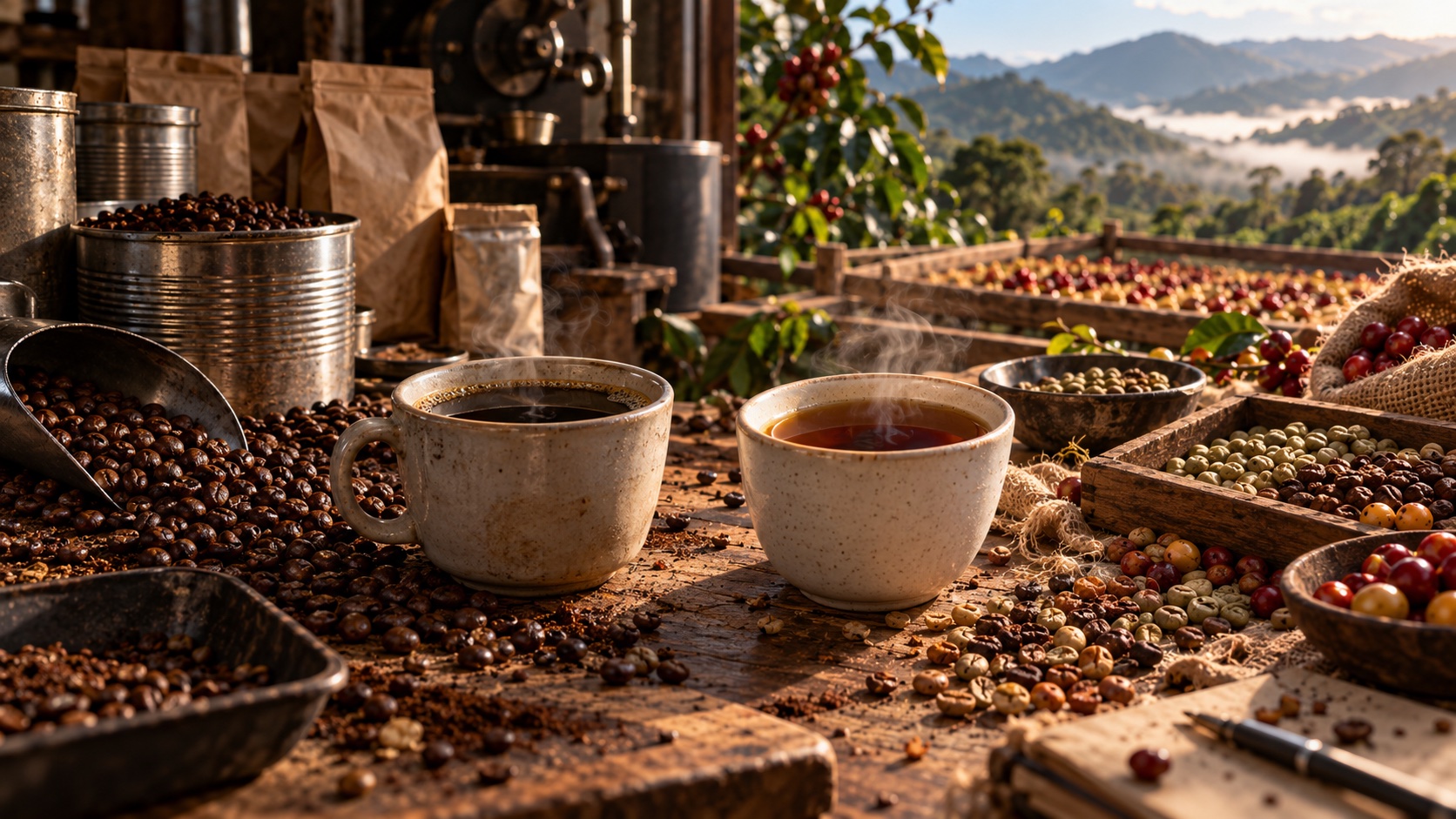
Pour a cup from a supermarket tin and a cup from a small-batch roaster, then leave both on the counter for twenty minutes. The first will taste much the same at the end as it did at the start, only cooler. The second will shift as it cools: sweeter, then brighter, sometimes with a fruit note that was not there when it was hot.
That small experiment is the whole difference between specialty vs commercial coffee. One is built to taste identical every time. The other is built to taste of a particular place and a particular harvest, and it accepts that no two years will be the same.
Neither approach is a scam, and neither is automatically better for you. They are two different answers to the same problem: coffee is a farm crop, and farm crops are unpredictable.
1. Specialty vs Commercial Coffee at a Glance
Facts and prices checked October 2026. Market prices and retail pricing change without notice.
| Commercial coffee | Specialty coffee | |
|---|---|---|
| Goal | The same taste, every bag, every year | The best expression of one lot, one harvest |
| Typical beans | Robusta and arabica, blended | Arabica, often a single farm or lot |
| Quality bar | No formal score required | 80 points or more on the SCA’s 100 point scale |
| How it changes | Recipe adjusted so it does not | Changes with each harvest and lot |
| Where flavour comes from | The blend and the roast | Origin, variety, processing and roast |
| Best brewed | Anywhere, including with milk and sugar | Freshly ground, measured, often black |
2. The Commercial Approach: Consistency as the Product
The word “commercial” here simply means coffee traded and sold at volume, priced off the global commodity market. It is not a 1970s invention. Coffee was a mass-traded commodity long before anyone thought to call some of it specialty, and the specialty idea grew up as a reaction against it.
What the commercial roaster sells is predictability. If you buy the same tin every week, you expect it to taste like last week’s tin, and the whole supply chain is organised to deliver exactly that.
Choosing hardy, high-yield beans
A large share of commercial coffee leans on robusta, the hardier of the two main coffee species. Robusta yields heavily, copes with heat and lower altitudes, and is more resistant to diseases such as coffee leaf rust, a fungus that has devastated arabica farms. You can read more on the two species in our arabica vs robusta guide.
- Robusta tends towards heavier body, more bitterness and less acidity
- It is cheaper to grow per kilogram, which matters at industrial volume
- The trade-off is flavour nuance, which commercial blends are not chasing anyway
Blending to cancel out the weather
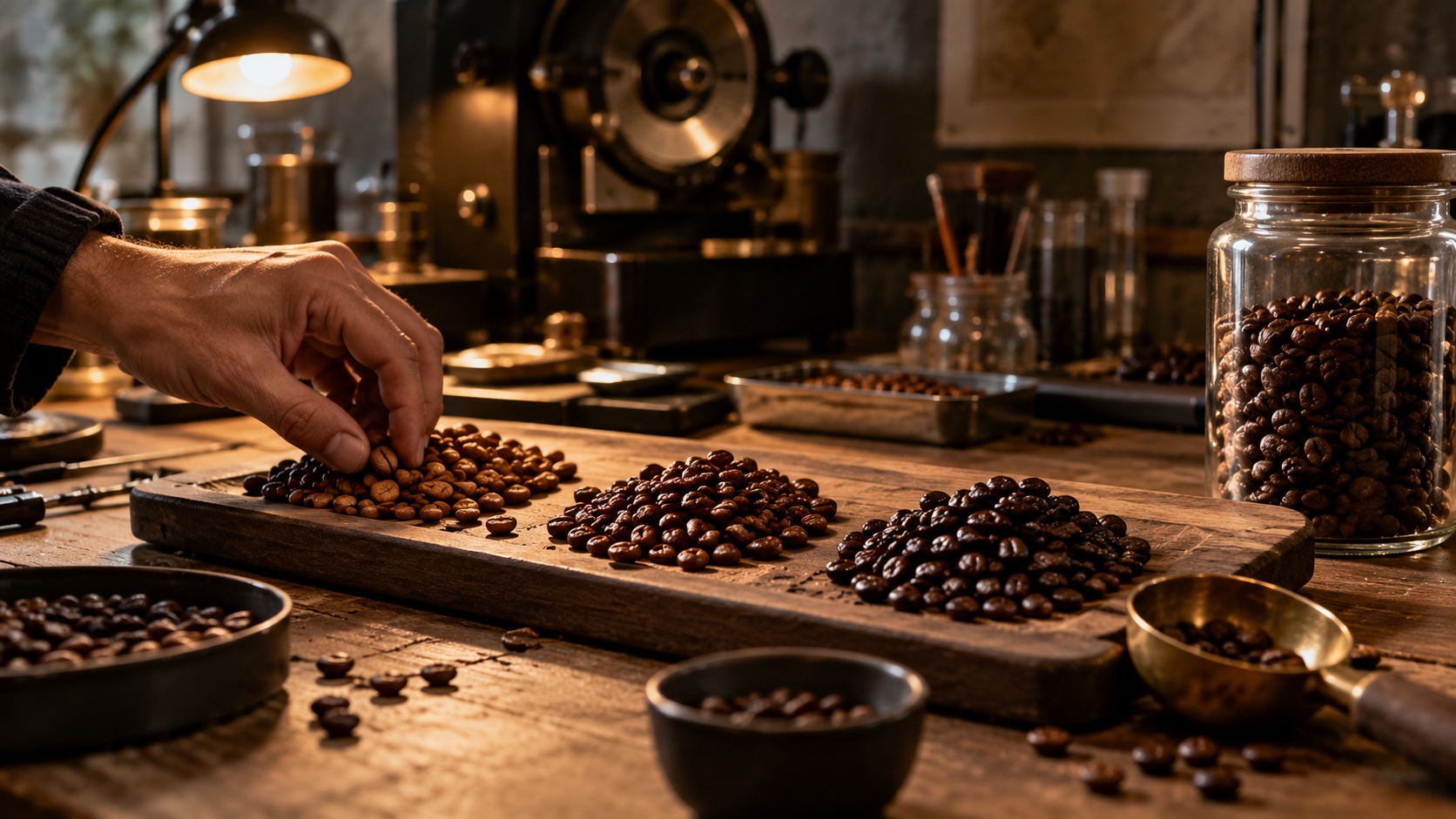
The heart of commercial coffee is the blend. A blend is a recipe of several component coffees, each chosen for a role: one for body, one for sweetness, one for a bit of brightness.
When a component changes, because a harvest was poor or a supplier ran short, the blender swaps in a different coffee that plays the same role. The recipe on paper changes so that the taste in the cup does not. Roasters routinely reformulate blends through the year for exactly this reason.
Priced by the futures market
Commercial coffee is priced off futures contracts. Arabica trades on the ICE “C” contract in New York, and robusta on a separate ICE contract in London.
Those prices move hard. Arabica futures peaked above $4.40 a pound in February 2025 after supply shortages in Brazil, then fell back to just under $2.90 a pound by 1 October 2026, roughly a third lower. A commercial brand absorbs swings like that through its blend and its pricing, which is one more reason consistency is the product it sells.
3. The Specialty Approach: Pursuing Terroir
The phrase “specialty coffee” was first used in 1974 by the importer Erna Knutsen, in the Tea & Coffee Trade Journal. She used it for beans of exceptional flavour grown in special microclimates, as distinct from the commodity coffee of the time.
The idea gained structure through trade bodies. The Specialty Coffee Association of America was founded in 1982, its European counterpart in 1998, and the two merged into a single Specialty Coffee Association (SCA) in January 2017.
What terroir means in a coffee cup
Terroir is a word borrowed from wine. It means the combined effect of place on taste: soil, altitude, rainfall, temperature and the plant variety growing there.
Specialty coffee treats that as the point. Instead of blending variation away, it isolates one origin, often one farm or one lot, so you can taste it. A washed Ethiopian lot might drink like jasmine tea and lemon. A natural processed Brazilian lot might lean towards cocoa, dried fruit and toffee.
Why specialty refuses to be consistent
Because the flavour comes from the harvest, the next harvest tastes different. A roaster may buy from the same farm year after year and still describe this year’s lot differently from last year’s.
To a commercial buyer that is a defect. To a specialty drinker it is the appeal: a bag of coffee is closer to a vintage than to a brand. The trade-off is real, though. A bag you loved may simply not come back. Our guide to single origin, SOE and blends covers how roasters label these differences.
4. How Specialty Coffee Is Scored
“Specialty” is not just a marketing word. For decades it has meant a coffee that scores 80 points or more on the SCA’s 100 point cupping scale.
Cupping is the professional tasting method. Coarsely ground coffee is steeped in bowls, the crust of grounds is broken, and trained tasters slurp from spoons. They return to the same bowls repeatedly as the coffee cools, because acidity, sweetness and body read differently at each temperature, and defects tend to show more clearly once the cup is cool.
- 80 points and up: the SCA’s long-standing threshold for specialty grade
- 87 points: the minimum score to win a Cup of Excellence award, the best known origin competition
- Over 90 points: Cup of Excellence gives these a Presidential Award; such lots are rare
- Late 2024: the SCA formally adopted its new Coffee Value Assessment (CVA), replacing the cupping form first published in 2004, and separating a description of the coffee from a judgement of how good it is
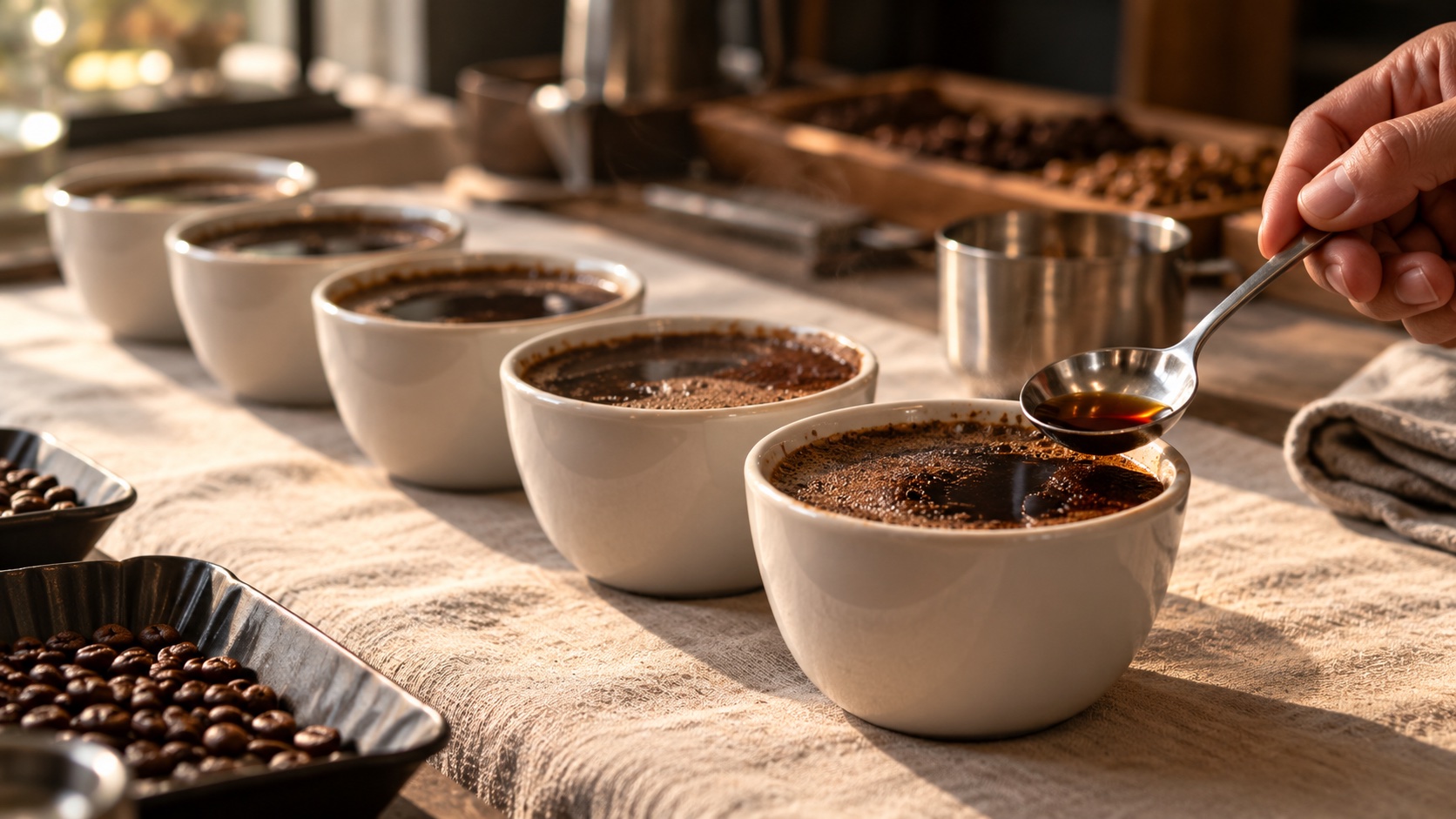
That cooling behaviour is why the counter-top experiment at the top of this article works. The changes cuppers look for are the same ones you notice at home.
5. The Specialty Value Chain, Step by Step
A specialty lot can be ruined at any stage, so each one is handled with more care than volume coffee can afford.
| Stage | What happens | What it changes in the cup |
|---|---|---|
| Green bean sourcing | Buying specific lots from specific farms and varieties | The ceiling on flavour: nothing later can add what is not there |
| Processing | Removing the fruit from the seed: washed, natural, honey, anaerobic | Clarity, sweetness, fruitiness and funk |
| Roasting | Each lot roasted to its own profile | How much origin character survives |
| Brewing | Grind, ratio, water temperature, time | Whether you actually taste any of the above |
Processing: where much of the flavour is decided
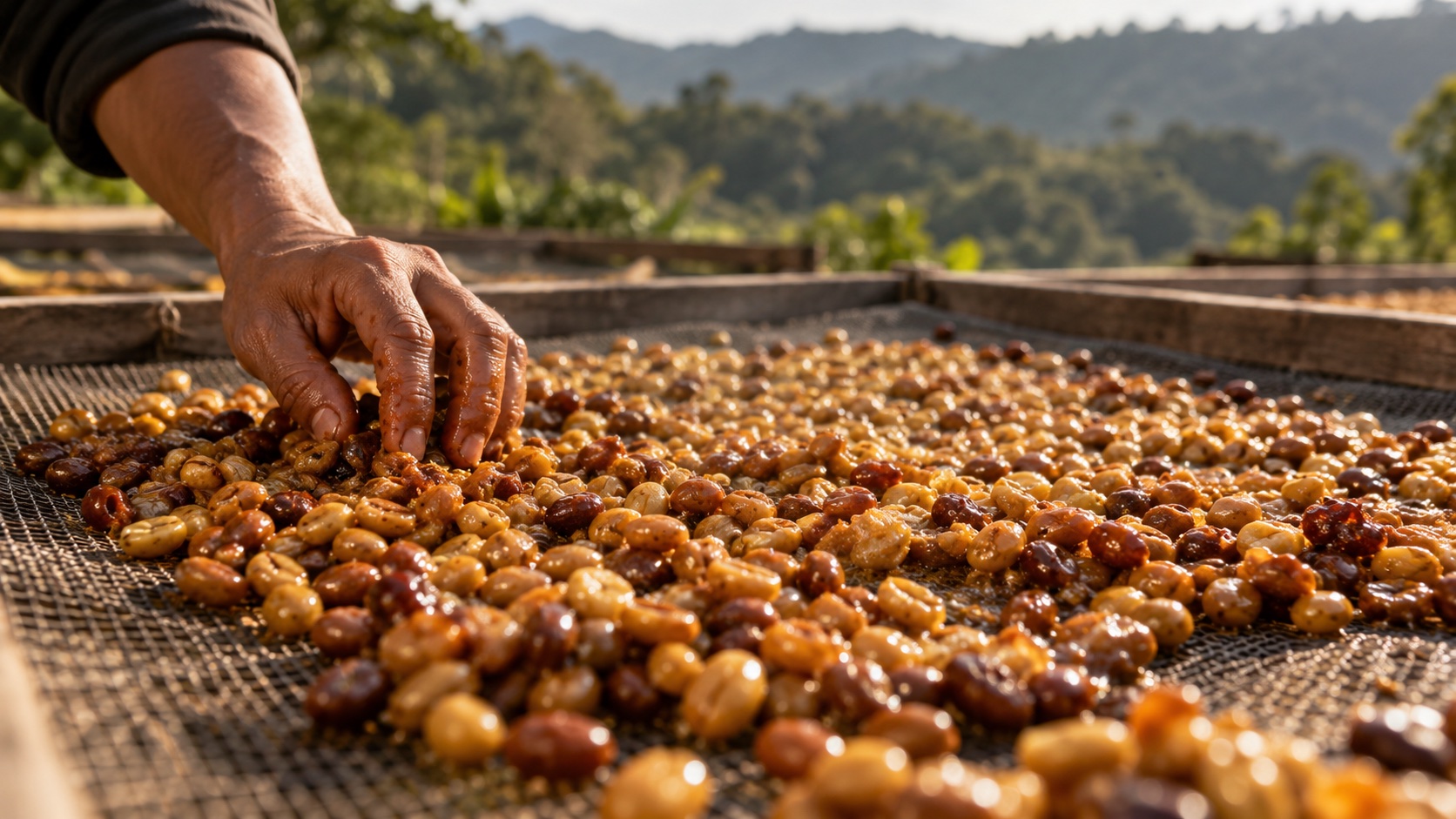
Every coffee bean is the seed of a fruit, and the fruit has to come off. How it comes off matters a great deal.
- Washed: the fruit is removed before drying, giving a clean, bright cup
- Natural: the whole cherry dries intact, giving heavier body and more fruit
- Honey: the skin is removed but some of the sticky fruit layer, called mucilage, is left on while the bean dries. Despite the name, no honey is involved
- Anaerobic fermentation: cherries or beans ferment in sealed tanks with oxygen pushed out by the carbon dioxide they release, which favours different microbes and can produce intense, winey or tropical flavours
A genuine caution here: experimental processing is not a guarantee of quality. Some anaerobic coffees taste boozy or vinegary, and plenty of drinkers find them tiring by the second cup. A clean washed coffee is often the better first specialty bag.
Roasting and brewing
Specialty roasters usually roast lighter, to keep origin character that a dark roast would flatten into generic roastiness. Our guide to light, medium and dark roasts explains what each level does.
The last link is you. Light roasted specialty coffee is less forgiving: grind too coarse or brew too cool and it tastes thin and sour, which many people wrongly blame on the bean.
6. Common Myths About Specialty and Commercial Coffee
- “Specialty coffee is just expensive branding.” It has a measurable bar: 80 points on a standardised tasting protocol. A roaster that publishes the farm, lot and processing method is giving you something you can check.
- “Single origin always means specialty.” It does not. A single origin can be ordinary, and a blend can be specialty grade. Our specialty coffee explainer goes further.
- “Consistency means low quality.” Consistency is a hard technical achievement. It just optimises for a different thing.
- “Light roast means more sour.” Light roast exposes acidity, but sourness usually means under-extraction, which is a brewing fix.
7. Which Should You Buy?
Buy specialty if
- You drink coffee black, or with a small splash of milk
- You enjoy noticing differences from bag to bag, the way some people enjoy wine
- You already grind fresh, or are willing to buy a burr grinder
- You can use a 250g bag within a few weeks of the roast date
Stick with commercial if
- You drink large milky coffees with sugar, where origin notes disappear anyway
- You want the same taste every morning and dislike surprises
- Price per cup matters more than flavour detail
- You use pre-ground coffee and do not plan to change that
The middle ground worth trying
If you are not sure, try a specialty roaster’s house blend before a single origin. It gives you the consistency of a blend with better green coffee and a fresher roast. Stumptown’s Hair Bender, for example, blends coffees from Central and South America, East Africa and Indonesia, and sells for about $19 to $20 per 12oz bag direct from the roaster in the US (checked October 2026). Most local specialty roasters offer something similar at a comparable price.
The honest catch with specialty is the cost of entry. The beans cost more, they are best used within a few weeks of the roast date, and without a decent grinder and a measured recipe you may pay double for a cup that tastes no better. Start with our guide to hand brew coffee at home before you spend.
FAQ
What is the difference between specialty and commercial coffee?
Commercial coffee is blended and roasted to taste the same every year, regardless of harvest. Specialty coffee scores 80 points or more on the SCA cupping scale and is sold to show the character of a specific origin, so it changes from harvest to harvest.
Is specialty coffee worth the higher price?
It is worth it if you drink coffee black and brew it carefully. If you drink large milk drinks with sugar, most of what you pay extra for is hidden, and a good commercial or house blend is better value.
What does an 80 point coffee score mean?
It means trained tasters scored the coffee at 80 or above on the SCA’s 100 point cupping scale, the long-standing line for specialty grade. Cup of Excellence winners must score at least 87, and lots above 90 are rare.
Why does my specialty coffee taste sour?
Usually because it is under-extracted, not because the bean is bad. Try a finer grind, hotter water or a longer brew time, since lighter roasts need more extraction than dark commercial roasts.
What is honey processed coffee?
It is coffee where the skin is removed but some of the sticky fruit layer, called mucilage, is left on while the bean dries. No honey is involved; the name refers to the texture. It tends to give a sweeter, rounder cup than washed coffee.
Can a blend be specialty coffee?
Yes. A blend qualifies if its components meet specialty grade. Many specialty roasters sell house blends that combine origins for balance and consistency.
Disclosure
Note: Brewing involves hot water and, for some methods, pressure or electrical appliances — always follow the manufacturer’s instructions.
No Comments