
De’Longhi Rivelia Start Review: The Bean Switch Is the Point
De’Longhi Rivelia Start Review: The Bean Switch Is the Point
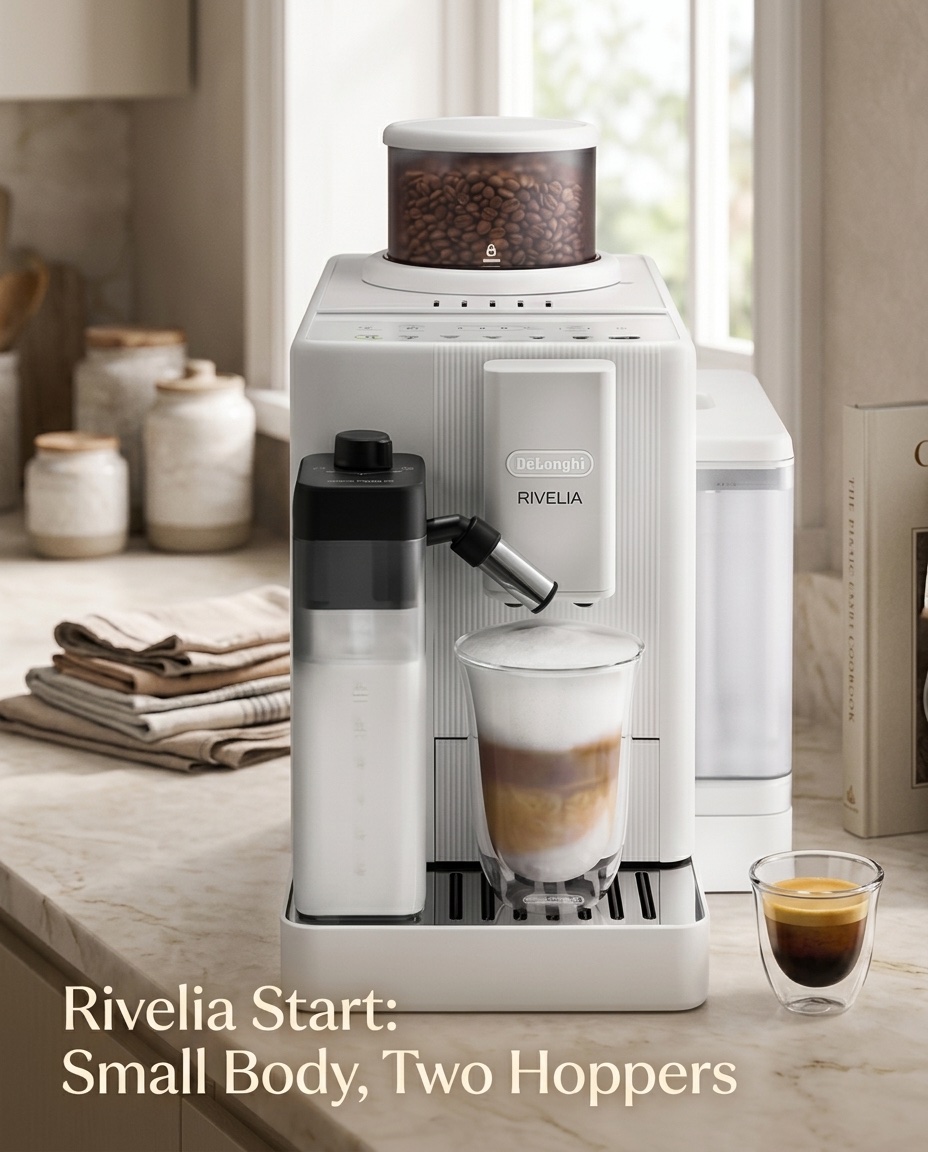
The Rivelia Start is worth buying for one reason: two sealed, interchangeable bean hoppers at a price where almost nothing else offers them. Everything else about it is competent rather than remarkable, and if you do not care about switching between two coffees, your money goes further elsewhere.
De’Longhi launched it in July 2026 as a more accessible addition to the Rivelia family, sitting below the original Rivelia that arrived in 2024. The pitch is a compact body, a simpler interface and menu, and the same Bean Switch system that made the first Rivelia interesting. The question is whether the simplification cut anything that matters.
1. Specifications at a Glance
Specs and prices checked September 2026 against De’Longhi’s own UK and Polish product listings. Models and pricing change without notice.
| Specification | De’Longhi Rivelia Start |
|---|---|
| Model range | EXAM420.55 (BW, GR, BXL, WXL) plus EXAM422.55.BG |
| Launched | July 2026 |
| UK RRP | 599.99 pounds |
| Europe RRP | around 649 euros, 2,399 zloty in Poland |
| Bean hoppers | Two, 250g each, interchangeable |
| Grinder | Conical steel burrs, adjustable |
| Pump pressure | 15 bar |
| Water tank | 1.4 litres |
| Grounds container | 10 servings |
| Milk system | LatteCrema Hot, automatic carafe |
| Drinks menu | 10 |
| Power | 1450 W |
| Weight | 9.7 kg* |
| Controls | Touch controls |
| Dimensions | 250 × 430 × 390 mm (W × D × H) |
*Weight note: De’Longhi’s current UK product page lists 9.4kg, while the user documentation gives 9.7kg; this article uses the user-documentation figure in the table.
The ten drinks are Espresso, Coffee, Filter Coffee, Iced Espresso, Iced Coffee, Cold Brew, Cappuccino, Flat White, Latte Macchiato and Hot Milk.
2. Who the Rivelia Start Is For
This machine is aimed squarely at one buyer: someone leaving capsules behind who wants fresh beans without learning anything.
- You want one button between you and a cappuccino, not a workflow
- You keep two coffees in the house, typically a regular and a decaf, or a medium roast and something darker
- Your counter space is genuinely tight
- You drink both hot and cold coffee depending on the season
- You accept an automatic machine’s ceiling on espresso quality in exchange for never having to think about it
It is not for anyone who wants to steer the extraction. There is no portafilter, no manual steam wand, and no realistic path to dialling in a shot the way you would on a traditional machine.
3. The Bean Switch System, and Why It Is the Whole Argument
Most bean-to-cup machines have one fixed hopper. Changing coffee means running the hopper empty, or grinding out the leftovers, which wastes beans and takes minutes. If you drink decaf in the evening, this is the daily friction that quietly kills the appeal of an automatic machine.
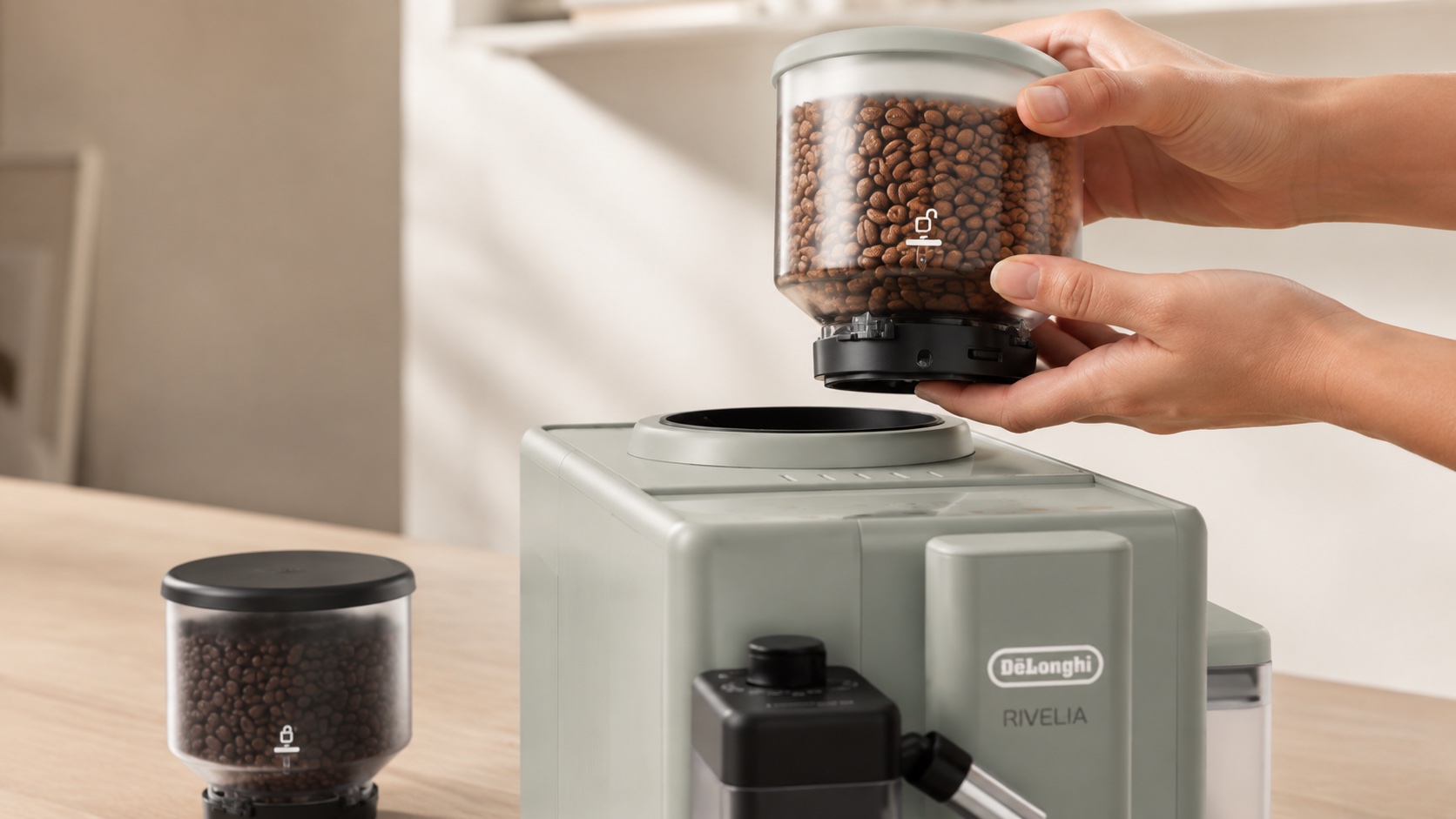
The Rivelia Start comes with two interchangeable 250g bean hoppers that can be swapped from the top of the machine. You lift one off, drop the other on, and the machine recognises the change. There is no purge cycle to sit through.
Two practical notes worth knowing before you buy:
- The hoppers seal when removed, so the beans you are not using are not sitting open to air. That matters more than it sounds; oxygen is what makes beans taste flat.
- A small amount of coffee remains inside the grinder itself after a switch. The first drink after changing beans carries a trace of the previous coffee. It is a mouthful, not a ruined cup, but a purist switching between a delicate light roast and a dark roast will notice the first shot.
At 599.99 pounds this feature is unusual at this price. Machines with interchangeable dual-hopper systems are not common in this segment.
4. Build, Size and the Dimensions Question
The Start is finished in textured plastic with touch controls on the front. Launch colours included Jade Green and Umber Brown, with Onyx Black and an Arctic White variant also in the range. It looks considerably better than the silver-and-black appliance aesthetic that dominates this category.
The Rivelia Start’s dimensions are 250 × 430 × 390 mm (W × D × H). That makes its compact footprint one of the machine’s genuine selling points, although the 43cm depth still deserves attention on a crowded counter.
The published weight is 9.7kg in the user documentation, while De’Longhi’s current UK product page lists 9.4kg. Either way, it is not useful to describe the Start as dramatically lighter than the full-size Rivelia. The more accurate description is a separate, simplified model within the family rather than simply a smaller version of the premium machine.
The number that actually decides whether a bean-to-cup machine fits is depth, not width, because the water tank and the bean hoppers both need clearance. At 43cm deep, the Start is compact enough for many standard counters, but you should still measure the available depth and the clearance above the machine before buying.
5. In Use, Day to Day
Setup is genuinely beginner friendly. The touch interface walks you through water hardness, the filter and the first rinse, and you can be making coffee inside fifteen minutes without opening the manual.
The interface is one of the strongest parts of the machine. Drinks are presented through the touch controls, with settings for strength and volume, and the machine prompts you when it wants rinsing or descaling rather than expecting you to remember.
Living with it involves the usual automatic-machine routine:
- Emptying a grounds container that holds 10 servings, so roughly every second or third day for a two-person household
- Rinsing the milk carafe, which can go in the fridge between uses
- Refilling a 1.4 litre tank, which is modest and will need topping up daily if you drink long coffees
The grinder is the loud part, as it is on every machine in this class. It is not an early-morning-in-a-flat proposition if anyone is still asleep.
The grinder has 13 grind settings, according to De’Longhi’s launch specifications.
6. Results in the Cup
Espresso from the Rivelia Start is good automatic-machine espresso: consistent, hot enough, reasonably sweet with a medium roast, with a crema that looks right. It is not going to trouble a well-dialled manual setup, and the 15 bar pump is worth noting because the full-size Rivelia is specified at 19 bar. In practice neither figure is a quality indicator, since real extraction happens around 9 bar and everything above that is headroom, but it does confirm the Start is a different machine underneath rather than the same one in a smaller shell.
Where the machine flatters itself is with medium and medium-dark roasts. Very light, dense specialty roasts are hard work for any automatic grinder at this price, and this one is no exception.
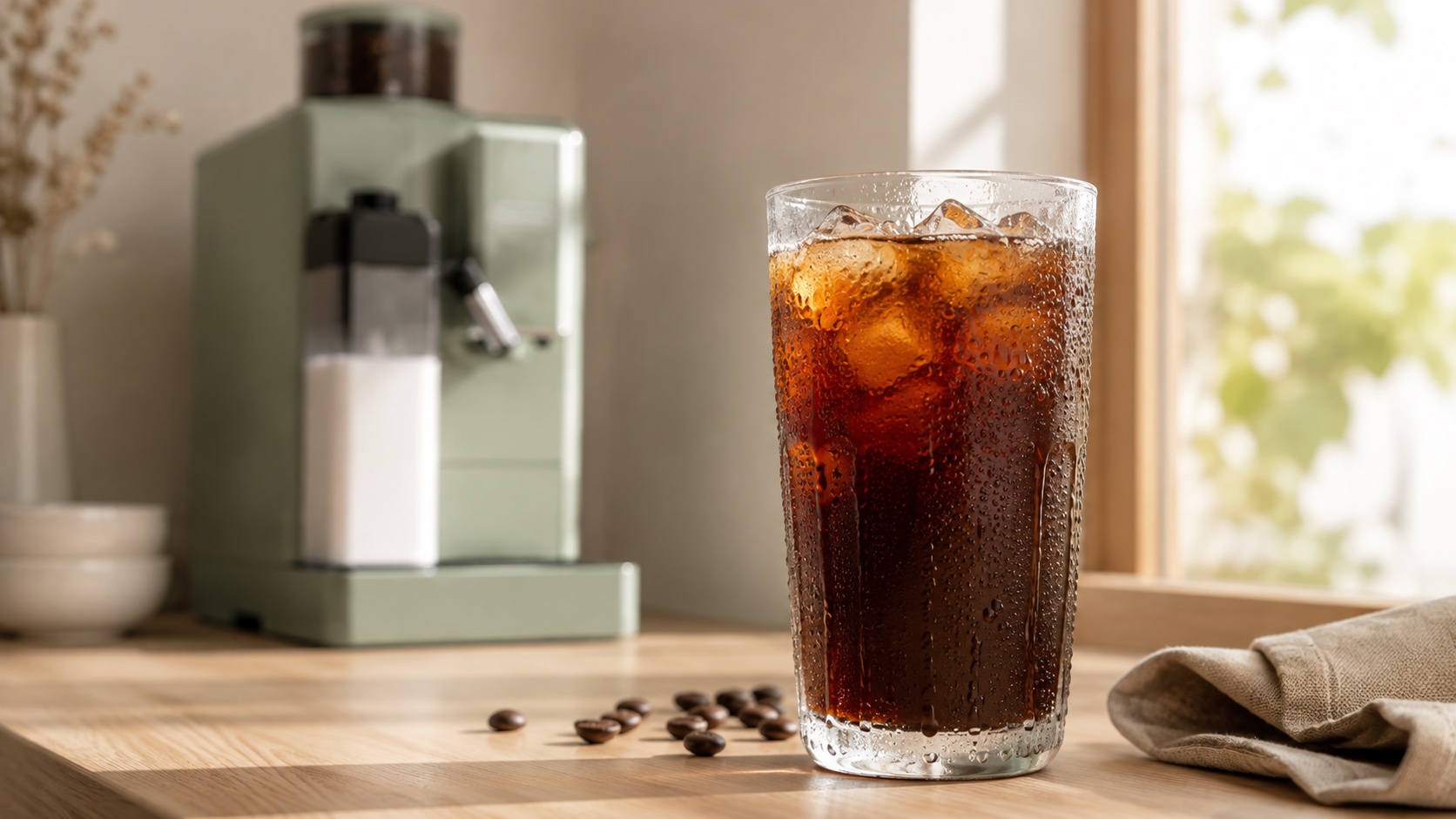
The cold drinks deserve a clear explanation, because the marketing is doing some work here. The Rivelia Start makes a cold coffee in under five minutes using cold extraction at ambient temperature, not steeped cold brew. Traditional cold brew sits for 12 to 24 hours, and that long, cool steep is what produces its characteristically low acidity and heavy body.
What you get here is a cold-extracted coffee that is smoother and less bitter than pouring hot espresso over ice, which is a real improvement, but it is not the same drink as overnight cold brew. If you want the genuine article, a jug and a night in the fridge still wins. If you want a decent iced coffee before work without planning ahead, this does the job well. Our review of the SMEG ECF03 and its own cold brew approach covers the same distinction on a very different machine.
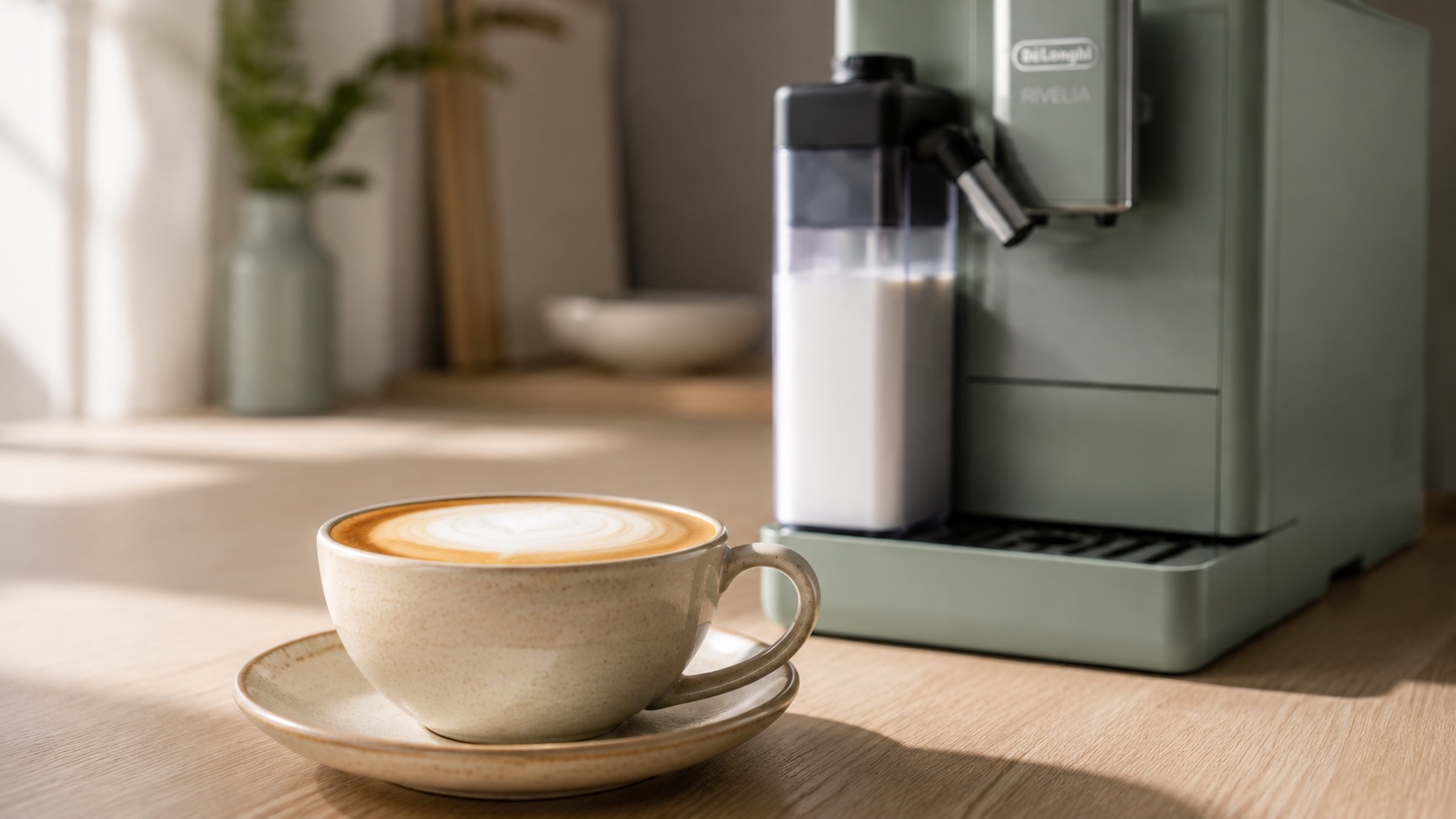
Milk is handled by the LatteCrema Hot carafe, which is automatic and produces dense, warm foam suited to cappuccino and flat white. It self-cleans after use and lives in the fridge between sessions.
The catch is worth being explicit about. Chilled milk foam is not included. The LatteCrema Cool set, which adds cold foam drinks, is a separate paid upgrade. Given how much of this machine’s marketing leans on cold drinks, buying the cold milk system separately is an easy thing to miss at checkout.
7. Buy It or Skip It
Buy it if
- You genuinely alternate between two coffees, especially caffeinated and decaf, and the daily purge is what has put you off automatic machines
- You are upgrading from capsules and want fresh beans with no learning curve
- You want hot and cold coffee from one machine without keeping a jug in the fridge
- You care how the machine looks on an open-plan counter
- You want an automatic milk system rather than a manual frothing wand
Skip it if
- You only ever drink one coffee. The second hopper is the reason for the price, and you would be paying for it unused
- You want to control extraction. Look at a manual machine such as the Gaggia Classic Evo Pro instead
- You want real cold brew rather than fast cold extraction
- Your counter depth is marginal and you cannot verify the machine’s dimensions before ordering
- You mainly drink iced milk-based coffee, since the cold foam system is an extra cost on top
- You want the widest drinks menu, since ten is a modest list at this price
8. Alternatives Worth Considering
De’Longhi Magnifica Start, roughly 250 to 330 pounds. The value pick. It gets fresh beans into a cup with no fuss for around half the money. You give up the second hopper, the automatic milk carafe, since it uses a manual panarello frother. If the Bean Switch is not your reason for buying, this is the honest recommendation.
The full-size De’Longhi Rivelia, 749.99 pounds RRP. Widely discounted since its 2024 launch, and at times it has been available close to the Start’s price. It has a larger drinks menu and the same Bean Switch system. Check both street prices on the day you buy, because if the gap is small the full-size machine is the better product.
Philips Series 4400 LatteGo, similar price bracket. Twelve drinks, a milk system that rinses in seconds with only two parts, and quieter operation. One hopper, so no bean switching. Our Philips LatteGo 4400 review goes into where its milk foam falls short of De’Longhi’s.
De’Longhi Maestosa, flagship pricing. If budget is not the constraint and you want dual hoppers done without compromise, the Maestosa review covers what the top of this range buys you.
If you are coming from pods and unsure whether a full bean-to-cup machine is overkill, the Philips Baristina is a simpler and cheaper way into fresh beans.
9. Verdict
The De’Longhi Rivelia Start is a good machine with one genuinely distinctive feature and a slightly awkward value proposition. The Bean Switch System is the real thing, solving a daily annoyance that no amount of specification improvement elsewhere would fix, and at 599.99 pounds it is the cheapest credible route to two sealed hoppers.
The reservations are real. De’Longhi is selling compactness without publishing dimensions, cold brew that is actually cold extraction, and a cold milk system that costs extra. None of these is disqualifying, but together they mean the marketing is running ahead of the machine.
Should you buy it? If you run two coffees in your kitchen and want an automatic machine, yes, and it is the obvious choice at this price. If you drink one coffee, buy the Magnifica Start at around half the price and spend the difference on better beans. Either way, check the full-size Rivelia’s street price first, because that discount decides which Rivelia is the smarter buy on any given week.
FAQ
Is the De’Longhi Rivelia Start worth it?
Yes, if you regularly switch between two types of coffee bean. The two interchangeable 250g hoppers are the feature that justifies the 599.99 pound price, and few machines near this money offer them. If you only drink one coffee, the cheaper Magnifica Start delivers similar cup quality for roughly half the outlay.
Does the Rivelia Start make real cold brew?
No, not in the traditional sense. It uses cold extraction at ambient temperature to produce a cold coffee in under five minutes, whereas genuine cold brew steeps for 12 to 24 hours. The result is smoother and less bitter than espresso poured over ice, but it does not have the body or low acidity of an overnight steep.
What is the difference between the Rivelia Start and the standard Rivelia?
The Start is the cheaper, simpler member launched in July 2026, with a 10-drink menu and a 15-bar pump, against the earlier Rivelia’s different specification set and 19-bar pump specification. Both share the Bean Switch System with interchangeable hoppers. The Start measures 250 × 430 × 390 mm and is specified at 9.7kg in its user documentation.
How many drinks does the De’Longhi Rivelia Start make?
Ten as standard: Espresso, Coffee, Filter Coffee, Iced Espresso, Iced Coffee, Cold Brew, Cappuccino, Flat White, Latte Macchiato and Hot Milk. Adding the optional LatteCrema Cool upgrade set unlocks further chilled milk drinks, but that system is sold separately.
Does the Rivelia Start come with an automatic milk frother?
Yes, it includes the LatteCrema Hot automatic carafe, which froths and dispenses milk without manual steaming and self-cleans afterwards. The carafe can be stored in the fridge between uses. Chilled milk foam requires the separate LatteCrema Cool set.
How big is the De’Longhi Rivelia Start?
De’Longhi specifies the Rivelia Start at 250 × 430 × 390 mm (W × D × H). Its user documentation gives a weight of 9.7kg, while the current UK product page lists 9.4kg. The 43cm depth is the figure most worth checking against your counter space.
Can you use the Rivelia Start for decaf and regular coffee?
Yes, and this is exactly what the Bean Switch System is designed for. You swap the sealed hopper rather than emptying and purging a fixed one, so the change takes seconds. A trace of the previous coffee remains in the grinder, so the first drink after a switch carries a hint of the bean you were using before.
Note: Some links on La Milan Cafe may earn us a commission at no extra cost to you, which helps support the work. Brewing involves hot water and, for some methods, pressure or electrical appliances — always follow the manufacturer’s instructions.
No Comments